
What's Happening?
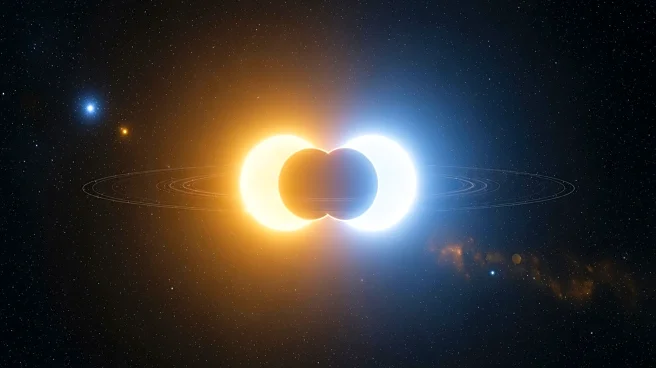
Astronomers from Northwestern University in Chicago have discovered a new exoplanet named 'HD 143811 AB b' that orbits two stars, reminiscent of the fictional planet Tatooine from the Star Wars franchise.
This gas giant is located approximately 446 light-years from Earth and is notable for its proximity to its twin light sources, being six times closer than any previously discovered similar planets. The discovery, detailed in the journal Astronomy & Astrophysics, provides a unique opportunity to study the dynamics of binary star systems and their planetary companions. The exoplanet was formed around 50 million years after the extinction of the dinosaurs, making it relatively young in cosmic terms. The research team, led by Jason Wang, utilized data from the Gemini South telescope collected nearly a decade ago to make this groundbreaking discovery.
Why It's Important?
The discovery of 'HD 143811 AB b' is significant as it enhances our understanding of planetary formation and dynamics in binary star systems, which are less common among the known 6,000 exoplanets. This finding allows scientists to observe and analyze the orbits of both the binary stars and the planet simultaneously, providing insights into the gravitational interactions and stability of such systems. The ability to directly image both the planet and its binary stars is rare and offers a valuable opportunity for further research. This could lead to advancements in our knowledge of how planets form and evolve in complex stellar environments, potentially influencing future astronomical studies and the search for habitable worlds.
What's Next?
Future research will likely focus on detailed observations of 'HD 143811 AB b' and its binary stars to understand their orbital mechanics and interactions. This could involve using more advanced telescopes and instruments to gather additional data and refine existing models of binary star systems. The findings may also prompt further exploration of other binary systems to identify similar planets, expanding our catalog of exoplanets and enhancing our understanding of the universe's diversity. Additionally, the study may inspire new theoretical work on the formation and evolution of planets in binary systems, potentially leading to new discoveries in the field of astronomy.