





What's Happening?
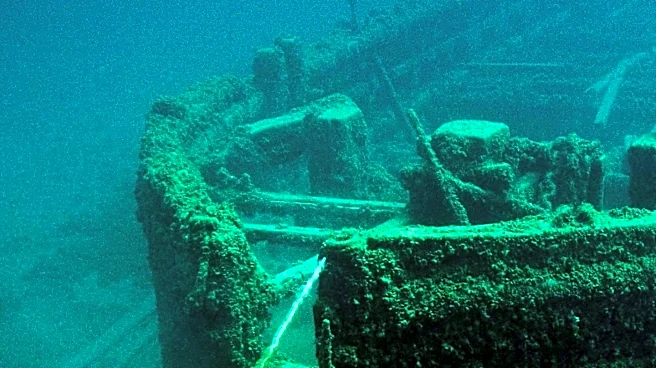
A federal judge has ruled that the state of Maine owns the remnants of the two-masted schooner Delhi, which has rested on the bottom of Somes Sound near Acadia National Park for over 125 years. The Delhi, carrying 32,000 granite paving stones, sank in 1893
and was discovered in late 2023 by a diver hired by a Southwest Harbor business. This business subsequently filed for ownership of the vessel, leading to a federal salvage rights dispute. Researchers have documented approximately 150 shipwrecks in the waters around Acadia National Park, including Mount Desert Island and the Schoodic Peninsula. The area around Baker Island, now part of the Town of Cranberry Isles, has been identified as a 'ship trap' and the site of the most wrecks found around Acadia. Other notable shipwrecks include the schooner Tay, which ran aground in 1911, and an unidentified wooden ship in Seal Cove excavated in 2012.
Why It's Important?
This ruling clarifies ownership of historical shipwrecks, setting a precedent for future salvage rights disputes in U.S. waters, particularly those within or near protected national park areas. The preservation of such wrecks is crucial for understanding maritime history, technological advancements in shipbuilding, and the economic activities of past eras. For Maine, state ownership means the Delhi wreckage can be managed as a cultural and historical resource, potentially allowing for archaeological study, public education, and responsible preservation. The dispute highlights the tension between private salvage interests and public heritage protection. The presence of numerous shipwrecks around Acadia National Park underscores the region's rich maritime past and the inherent dangers of sea travel, offering valuable insights into historical trade routes, coastal communities, and the challenges faced by mariners. This decision ensures that these underwater historical sites are protected for their scientific and educational value rather than being exploited for commercial gain.
What's Next?
Following the federal judge's ruling, the state of Maine will likely proceed with plans for the management and potential study of the Delhi wreckage. This could involve marine archaeological surveys to further document the vessel and its cargo, as well as developing strategies for its long-term preservation. The ruling may also influence how other unidentified or disputed shipwrecks in Maine's waters are handled, potentially leading to more state-led preservation efforts. For the Southwest Harbor business that initiated the salvage claim, the ruling means they will not gain ownership of the Delhi. This case could serve as a legal benchmark for similar situations involving historical artifacts found in public or protected waters across the U.S., encouraging collaboration between private entities and state authorities to ensure the protection of cultural heritage. Future actions will likely focus on integrating these historical sites into educational programs and potentially making them accessible for controlled exploration.
Beyond the Headlines
The story of the Delhi and other shipwrecks around Acadia National Park delves into the deeper cultural and historical narrative of maritime life in the U.S. Northeast. These submerged artifacts are not merely relics but time capsules, offering tangible links to past industries, such as granite quarrying and lumber trade, and the lives of those who worked on the sea. The legal battle over the Delhi's ownership reflects a broader societal debate about who controls historical heritage—private individuals seeking profit or the public for collective memory and study. This case reinforces the principle that significant historical sites, especially within national park boundaries, are often considered public trust resources. The ongoing research and documentation of these wrecks contribute to a more complete understanding of American history, providing insights into economic development, technological evolution, and the human struggle against natural forces. It also highlights the role of marine archaeology in uncovering and interpreting these submerged stories, enriching our collective heritage.