




What's Happening?
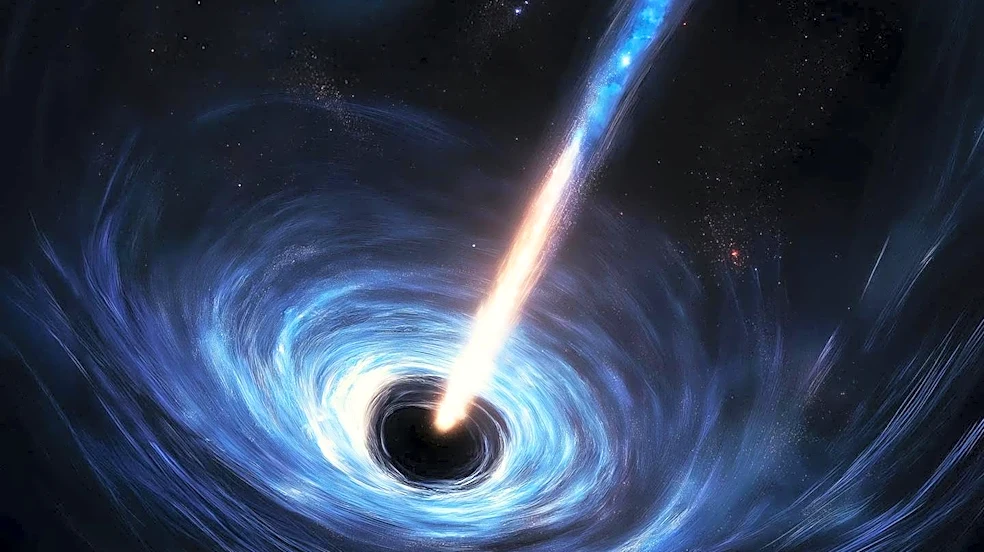
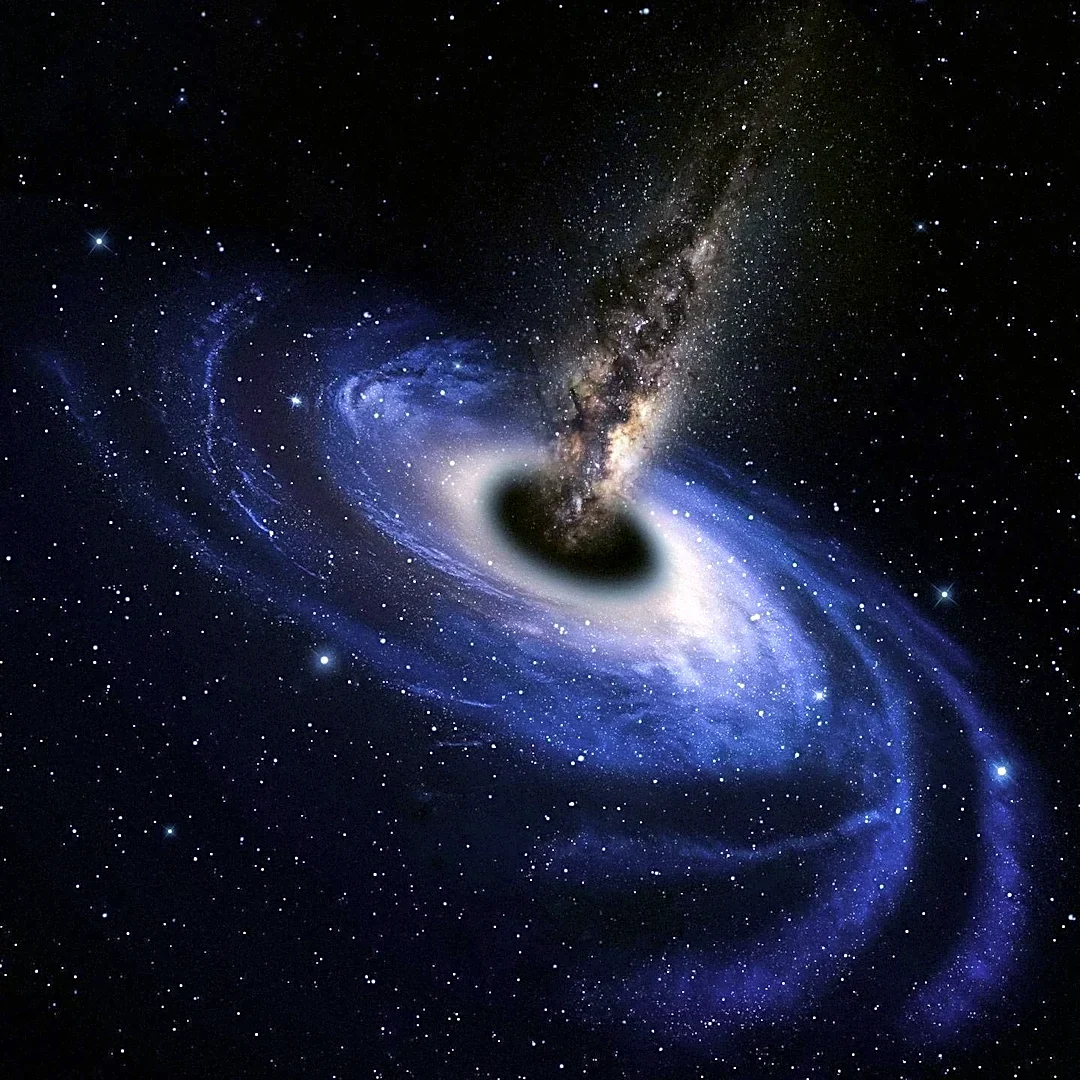
A black hole system, IRAS 18293-0941, located 12,000 light-years from Earth, has been identified as firing a plasma jet almost directly towards our planet. This system consists of a hot, massive star orbiting a black hole approximately every 11.38 days.
The black hole draws material from its companion star, expelling some of it outwards in opposing jets traveling at about three-quarters the speed of light. Researchers have identified this system as a strong candidate for the Milky Way's first microblazar, a type of microquasar whose jet is pointed towards the observer. The discovery was made by combining data from the European VLBI Network, MeerKAT in South Africa, the Calar Alto Observatory, and archival Very Large Array records, as the system is hidden at optical wavelengths by dense interstellar dust. Despite the jet's direction, scientists confirm there is no known or expected danger to Earth due to the immense distance.
Why It's Important?
This discovery is significant for astrophysics as it provides a unique opportunity to study extreme physics within our galaxy. IRAS 18293-0941 acts as a close-up laboratory for understanding how black holes accelerate particles and how relativistic jets interact with interstellar gas. The research could shed light on the origin of ultra-high-energy cosmic rays that reach Earth's upper atmosphere, whose sources remain largely unknown. While some coverage has inaccurately described the jet as 'radioactive goo,' it is actually plasma, which is ionized matter associated with high-energy radiation and particle acceleration, not a radioactive substance or a solid stream on a collision course with Earth. The system's blazar-like geometry, comparable to distant extragalactic blazars, offers scientists a rare, nearby object for study on a human timescale using existing ground-based instruments.
What's Next?
Researchers will continue to study IRAS 18293-0941 to further understand its properties and behavior. One area of focus will be to observe expected jet variability, which has not yet been confirmed, possibly due to a dense circumstellar environment masking it. The study, accepted in Astronomy & Astrophysics, also notes a proposed connection between this system and the nearby ultra-high-energy gamma-ray source LHAASO J1831-1007u. Future research will aim to confirm or refute this link, which is currently described as an interpretation rather than an established causal relationship. Continued observation and analysis of this microblazar candidate will contribute to a deeper understanding of black hole physics and cosmic ray origins.
Beyond the Headlines
The identification of IRAS 18293-0941 as a potential microblazar highlights the ongoing advancements in astronomical observation and data analysis techniques. The ability to detect and characterize such distant and obscured phenomena underscores the power of combining multiple observational facilities and archival data. This discovery also serves as a reminder of the vast and dynamic nature of the universe, where extreme physical processes are constantly occurring. The scientific community's careful distinction between theoretical possibilities and actual threats, as seen in the reassurance that the jet poses no danger to Earth, is crucial for maintaining public trust and preventing misinformation regarding cosmic events. This research contributes to humanity's fundamental understanding of the universe, pushing the boundaries of our knowledge about black holes and high-energy astrophysics.