





What's Happening?
NASA has announced updates to the Artemis 3 mission, which is set to be a critical test flight before the agency attempts to land humans on the Moon for the first time in decades. Following the success of Artemis 2, which sent astronauts around the Moon,
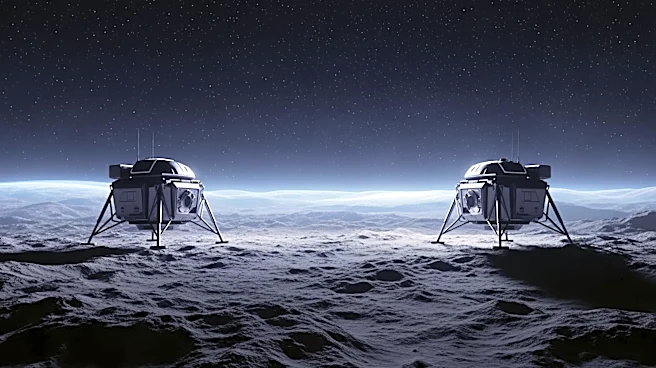
Artemis 3 will focus on testing the Orion capsule's ability to dock with a human landing system (HLS). The mission will involve both SpaceX's Starship and Blue Origin's Blue Moon Mark 2, as confirmed by NASA officials. The mission will remain in low-Earth orbit, testing rendezvous and docking capabilities between Orion and the commercial landers. This mission is a precursor to the planned lunar landing in Artemis 4, scheduled for 2028. NASA is also working on integrating more partners and operations into the mission to enhance the interaction between Orion, the crew, and ground teams.
Why It's Important?
The Artemis 3 mission is pivotal for NASA's long-term lunar exploration goals. By involving both SpaceX and Blue Origin, NASA aims to foster competition and innovation in the development of lunar landers. This mission will test critical technologies and systems necessary for future lunar landings, including life support and docking capabilities. The success of Artemis 3 could significantly impact the timeline and strategy for subsequent Artemis missions, particularly the planned lunar landing in Artemis 4. The mission also represents a substantial investment in commercial partnerships, with NASA having spent nearly $7 billion on HLS development. The outcome of Artemis 3 will influence future funding and development decisions, potentially affecting the broader space exploration industry.
What's Next?
NASA plans to finalize the mission's duration, crew selection timeline, and potential demonstrations of next-generation spacesuits in the coming weeks. The agency is also seeking partners for small satellite experiments. The mission's success will depend on the readiness of SpaceX and Blue Origin's landers, which are currently behind schedule. NASA will need to address any technical challenges, such as the integration of a new heat shield and the development of a new SLS upper stage. The results of Artemis 3 will inform the planning and execution of Artemis 4, which aims to achieve the first crewed lunar landing since the Apollo era.