







What's Happening?
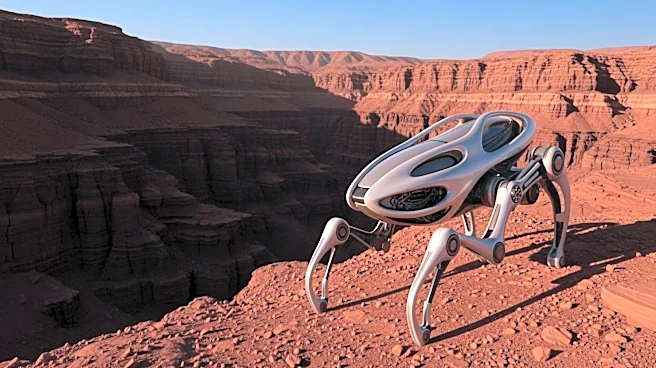
The German Space Agency at the German Aerospace Center (DLR) is advancing a novel approach to Mars exploration with the Valles Marineris Explorer (VaMEx). This initiative aims to design an autonomous, heterogeneous robot swarm to explore the Valles Marineris,
often referred to as the 'Grand Canyon' of Mars. The project leverages driving, walking, and flying systems to investigate the diverse environmental characteristics of this expansive area. The VaMEx team is focused on integrating various robotic concepts to efficiently cover large areas of Mars, enhancing the understanding of its terrain and potential for future exploration.
Why It's Important?
The development of the VaMEx project is significant for space exploration as it represents a shift towards more autonomous and versatile robotic systems. By employing a swarm of robots with different capabilities, the initiative could greatly enhance the efficiency and scope of Mars exploration missions. This approach not only promises to provide more comprehensive data about the Martian environment but also sets a precedent for future missions to other planets. The success of such technology could lead to advancements in autonomous systems, benefiting industries that rely on robotics and artificial intelligence.
What's Next?
The next steps for the VaMEx project involve further testing and refinement of the robot swarm concept. As the project progresses, it will likely attract interest from international space agencies and private companies looking to collaborate on Mars exploration. The outcomes of these tests could influence the design and deployment of future robotic missions to Mars, potentially leading to more ambitious exploration goals. Stakeholders in the space industry will be closely monitoring the project's developments to assess its viability and potential applications.
Beyond the Headlines
The VaMEx initiative highlights the growing trend of bio-inspired technology in space exploration. By mimicking natural systems, these technologies can offer innovative solutions to complex challenges faced in extraterrestrial environments. The ethical implications of deploying autonomous systems in space also warrant consideration, as they raise questions about the control and decision-making processes in remote exploration. Long-term, the success of such projects could lead to a paradigm shift in how humanity approaches the exploration of other planets.