








What's Happening?
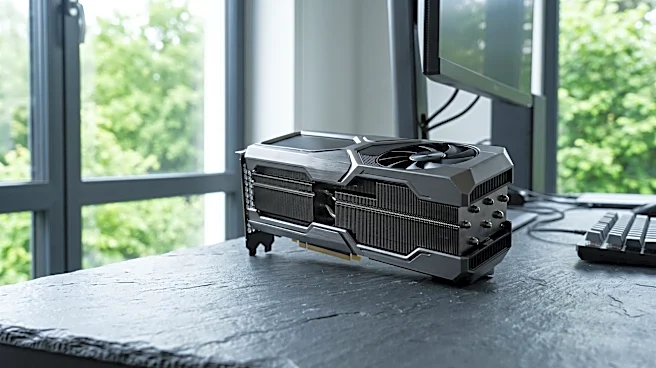
An open-source GPU unlock mod, developed by GitHub user Zagitta, is enabling NVIDIA RTX 30-series graphics cards to achieve substantial increases in AI compute performance. The mod, a Linux kernel module, allows higher Tensor Core instruction-issue rates
on supported NVIDIA Ampere GPUs by targeting compute restrictions affecting FP16 and BF16 operations with FP32 accumulation. These operations typically run at a reduced rate on GeForce GPUs compared to their professional counterparts. Benchmarks on an RTX 3090 Ti show BF16 compute performance increasing by nearly 80%, and TF32 throughput by 94%. Real-world AI workloads, such as those in ComfyUI, have demonstrated throughput gains of almost 60%. Similar unlocking techniques are also being extended to RTX 40-series graphics cards through a separate project called GPU Unlock Ada.
Why It's Important?
This development is highly significant for enthusiasts and researchers utilizing older NVIDIA hardware for local AI workloads. It effectively unlocks previously restricted computational power, providing a cost-effective way to enhance AI processing capabilities without requiring new hardware. The substantial performance gains, particularly in BF16 and TF32 operations, can accelerate AI model training, inference, and other compute-intensive tasks. This could democratize access to higher AI performance, allowing a broader range of users to engage in advanced AI development and experimentation. Furthermore, it highlights the inherent capabilities of consumer-grade GPUs that are often software-limited, potentially influencing future hardware and software design strategies by manufacturers.
What's Next?
The open-source nature of the GPU unlock mod means that community testing and development will likely continue to expand its compatibility and refine its performance across various NVIDIA Ampere and Ada Lovelace GPUs. While the primary focus is currently on Linux, experimental Windows UEFI implementations are also emerging. The ongoing work on RTX 40-series cards, such as the RTX 4090 and RTX 4070 Ti SUPER, suggests that even newer generations of GPUs could benefit from similar optimizations. This trend could lead to increased demand for older, more affordable GPUs for AI applications, as users seek to maximize their hardware investments. However, it also raises questions about NVIDIA's official stance on such modifications and potential future software updates that might impact their functionality.
Beyond the Headlines
The emergence of GPU unlock mods like Zagitta's highlights a fascinating tension between hardware capabilities and software-imposed limitations. It reveals that consumer-grade GPUs often possess more raw computational power than officially advertised or enabled for specific tasks, particularly in AI. This raises ethical and economic questions about product segmentation and whether manufacturers intentionally limit performance to differentiate between consumer and professional product lines. From a broader perspective, this community-driven effort to unlock hardware potential underscores the power of open-source development in challenging established norms and empowering users. It could foster a more transparent approach to hardware capabilities and encourage manufacturers to reconsider their software-defined performance restrictions, potentially leading to more versatile and user-friendly products in the future.