






What's Happening?
The Pacific Time Zone, encompassing a significant portion of the U.S. and Canada, observes a seasonal clock system that alternates between Pacific Standard Time (PST) and Pacific Daylight Time (PDT). PST is 8 hours behind Coordinated Universal Time (UTC-8)
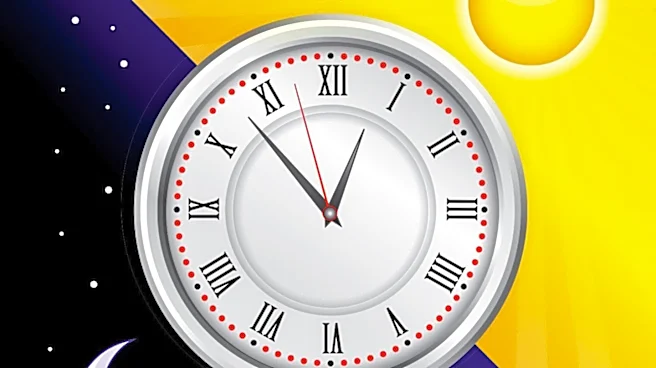
and is in effect during late fall and winter. PDT is 7 hours behind UTC-7 and is observed during spring and summer. The transition to PDT, known as "spring forward," occurs at 2:00 a.m. local time, skipping the hour between 2:00 a.m. and 3:00 a.m., effectively causing a loss of an hour of sleep. Conversely, the "fall back" transition in November sets clocks back one hour at 2:00 a.m., resulting in the hour between 1:00 a.m. and 2:00 a.m. occurring twice, providing an extra hour of sleep. These transitions are governed by national and international standards, including the U.S. Energy Policy Act of 2005.
Why It's Important?
The biannual clock changes in the Pacific Time Zone have significant practical implications for millions of individuals and various sectors. The "spring forward" transition, while extending evening daylight, has been linked to disruptions in sleep patterns and a slight increase in health and safety incidents, such as heart attacks and traffic accidents. For businesses, particularly those involved in global commerce, precise understanding of PST and PDT is crucial for coordinating meetings, scheduling flights, and ensuring digital systems operate without error. The one-hour shift can cause confusion in international communications and scheduling software if not carefully managed. The reliance of computer servers, financial markets, and encrypted communications on accurate timestamps makes the correct implementation of Daylight Saving Time rules a critical task for software developers and system administrators.
What's Next?
The debate over the permanence of Daylight Saving Time continues, with several U.S. states, including California and Washington, having passed legislation to make DST permanent, pending federal approval. If such a change were to occur, it would eliminate the biannual clock changes, creating a more stable time environment but permanently shifting an hour of daylight from the morning to the evening. For now, the current system remains the standard, making the navigation of PST and PDT an essential skill for anyone operating on the West Coast. Future discussions will likely revolve around balancing the benefits of extended evening daylight for retailers and event planners against concerns for public health and energy consumption. The ongoing need for precise time synchronization in the digital world will continue to drive updates and refinements in how these transitions are managed across various technological platforms.
Beyond the Headlines
The mechanics of Daylight Saving Time, particularly the "missing" or "gained" hour, highlight the profound impact of arbitrary time adjustments on human physiology and societal rhythms. The disruption to circadian rhythms, even for a single hour, can have measurable effects on health and well-being. Culturally, the transitions are often met with mixed feelings, with some appreciating the extended evening daylight and others lamenting the loss of morning light. This ongoing societal negotiation reflects a deeper tension between human-centric design and the natural light cycles. The complexity of managing these shifts in an increasingly interconnected digital world also underscores the hidden infrastructure of timekeeping, where precise synchronization is a critical, yet often overlooked, component of modern life and global commerce. The debate over DST's future is not just about time, but about how society chooses to balance economic interests, public health, and environmental considerations.