



What's Happening?
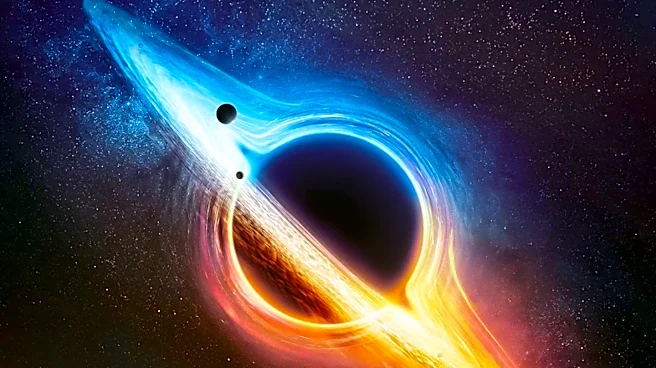
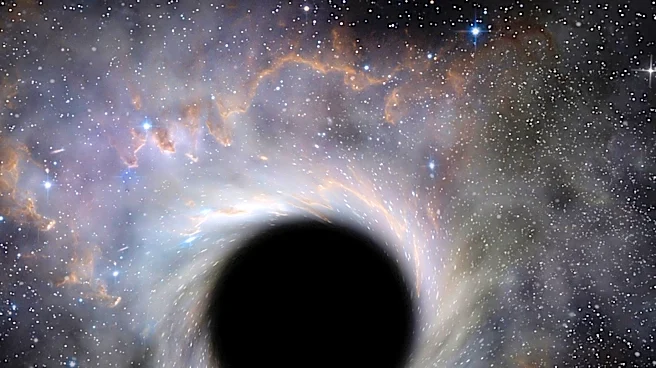
A new theoretical study led by Richard Pinčák, published in General Relativity and Gravitation, suggests a potential solution to the longstanding black hole information paradox. This paradox, first identified by Stephen Hawking in the 1970s, arises from
the apparent contradiction between quantum mechanics and the evaporation of black holes, which seems to destroy information. The study proposes that black holes do not completely evaporate but leave behind stable remnants that can store information. The researchers utilized Einstein-Cartan theory, which allows for spacetime torsion, to demonstrate that this torsion creates a repulsive force preventing complete gravitational collapse. The remnants, predicted to have a mass of about 9*10^-41 kg, could store vast amounts of quantum information, potentially resolving the paradox.
Why It's Important?
The proposed solution to the black hole information paradox could have significant implications for both theoretical physics and our understanding of the universe. By suggesting that black hole remnants can store information, the study aligns with quantum mechanics' principle that information cannot be destroyed. Additionally, the research connects this solution to the mass hierarchy problem in particle physics, offering a geometric explanation for the mass of fundamental particles through the Higgs field. This could lead to a deeper understanding of the universe's structure and the fundamental forces at play. If proven correct, the theory could unify several outstanding problems in physics, providing a new framework for future research.
What's Next?
The study's predictions, while currently beyond the reach of existing particle accelerators like the Large Hadron Collider, could be tested through astronomical observations. The stable black hole remnants might contribute to dark matter, and their gravitational effects could be detected. Additionally, the model's predictions about information encoding in remnants' vibrations could be investigated. The high energy scales involved suggest that traces of the proposed 7-dimensional geometry might be found in the Cosmic Microwave Background or primordial gravitational waves. These avenues offer potential paths for validating the theory and advancing our understanding of the universe.
Beyond the Headlines
The study's implications extend beyond resolving the black hole information paradox. By integrating concepts from quantum mechanics, general relativity, and particle physics, it proposes a unified framework that could reshape our understanding of reality. The idea that extra dimensions and spacetime torsion play a fundamental role in the universe's structure challenges traditional views and opens new avenues for exploration. If the theory holds, it could lead to a paradigm shift in physics, influencing future research directions and potentially leading to new technological advancements based on a deeper understanding of the universe's fundamental laws.