




What's Happening?
Andrew Jones, a researcher with Noah's Ark Scans, has presented new findings regarding a peculiar rock formation on Turkey's Mount Ararat, which he suggests could be evidence of Noah's Ark as described in the Book of Genesis. The formation, first discovered
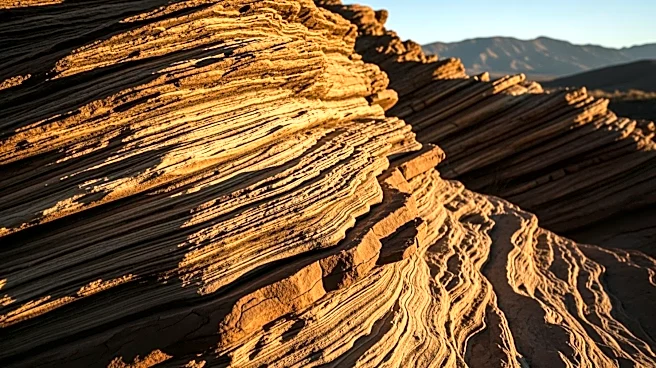
in 1959, has been the subject of various studies. Jones claims that ground-penetrating radar scans and soil samples reveal a series of corridors beneath the earth that match the dimensions of the biblical ark. These tunnels, running through the 'boat' and along its edges, lead to a central cavity referred to as the atrium. Additionally, fossil remains, ancient coral, and seashells found at the site, located 6,500 feet above sea level, may indicate that the area was once underwater, potentially supporting the Great Flood narrative. Jones and his team are considering further exploration of these tunnels using a robotic device.
Why It's Important?
The findings could have significant implications for both historical and religious communities, potentially providing physical evidence for a story that has been a cornerstone of biblical history. If proven true, this discovery could influence theological discussions and historical interpretations of ancient texts. The research also highlights the intersection of science and religion, where archaeological evidence may support or challenge long-held beliefs. For the scientific community, these findings could offer insights into ancient geological and environmental conditions, contributing to our understanding of historical climate events and tectonic activity.
What's Next?
Jones and his team plan to continue their investigation by deploying a robotic, remote-controlled device to explore the tunnels further. This exploration could provide more detailed data on the structure and composition of the formation, potentially uncovering more evidence to support or refute the Noah's Ark hypothesis. The results of these explorations could prompt further academic and theological debate, as well as inspire additional research into similar formations worldwide.