







What's Happening?
Representative Steve Womack attended the ribbon-cutting ceremony for Swarm Aero's new 80,000-square-foot plant in Fayetteville, Arkansas, on February 17. This facility, located in the former Keytronic building near Drake Field, is central to Swarm Aero's efforts
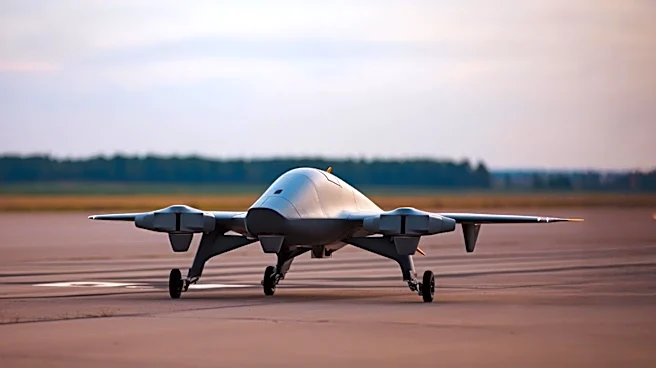
to develop Gamera, an affordable military drone designed as a sub-$10 million alternative to the MQ-9 Reaper. Swarm Aero, founded in 2022, has secured approximately $59 million in funding, including a $35 million Series A round, and over $10 million in Air Force Research Laboratory contracts specifically for high-rate manufacturing. The company aims for Gamera to meet the Air Force's requirement for a drone capable of long-range firepower and persistent sensing, particularly in a Pacific battlespace where U.S. bases could be vulnerable. Despite local opposition regarding zoning and business licenses, the Fayetteville City Council voted 5-3 on May 20 to allow Swarm Aero to continue operations, ensuring the factory's survival through its initial challenges.
Why It's Important?
The development of Gamera by Swarm Aero is a significant step in the U.S. military's strategy to acquire more affordable and attritable unmanned aerial systems. The Air Force's Massed Modular Aircraft program, which Gamera is designed to address, emerged from the high cost and losses of MQ-9A Reapers in recent conflicts. With Reapers costing $30 million to $50 million each, the military seeks a drone that can be produced in large numbers and replaced without prohibitive financial strain. Gamera's design emphasizes extreme range, heavy payloads, simple production, and low cost, aiming to provide long-range strike capabilities and persistent sensing without risking aircrews. This initiative reflects a broader shift in defense procurement towards distributed mass to counter sophisticated air-defense systems, potentially altering the dynamics of future conflicts and reducing the financial burden of military operations.
What's Next?
Swarm Aero's immediate next steps involve building, flying, and connecting Gamera, as the aircraft has not yet flown. The company targets a first flight in 2027 and is required by the government to produce a full-scale prototype within 21 months of contract award. Swarm Aero must prove its claims regarding range, payload, price, and coordinated flight capabilities outside of controlled environments. The company's Legion command-and-control system, which allows one operator to manage multiple unmanned systems, will also need to demonstrate its effectiveness in complex operational scenarios, such as controlling 80 Gameras under jamming conditions. The success of Gamera could influence future defense spending and procurement strategies, potentially leading to more widespread adoption of attritable drone technology across the U.S. military.
Beyond the Headlines
The concept of 'attritable' aircraft, central to Gamera's design, carries deeper implications for military strategy and public perception. While the Air Force states 'attritable' does not mean 'expendable,' the term allows planners to budget for anticipated losses without explicitly communicating these planned losses to Congress or taxpayers. This linguistic nuance could mask the true cost and human-machine interaction dynamics of future warfare. The shift towards systems like Gamera also highlights a strategic pivot from 'exquisite platforms' to distributed mass, challenging decades of doctrine focused on highly capable but expensive individual assets. This change could lead to ethical debates about the value of unmanned systems versus human lives in combat and the long-term economic sustainability of such a strategy, as the true cost will include sensors, software, maintenance, and weapons, beyond the advertised airframe price.