



What's Happening?
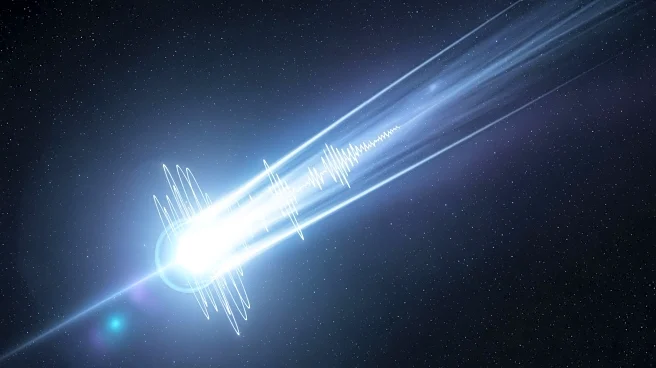
The interstellar object 3I/ATLAS has been observed to exhibit a unique pulsing pattern, brightening and dimming every 16.16 hours. This phenomenon has intrigued scientists and sparked discussions about its implications. Initially, it was thought that
the comet's rotation might cause the brightness changes, but new data from NASA's Hubble Space Telescope revealed that the light emanates from a large cloud of gas and dust, known as a coma, surrounding the comet. The pulsing is attributed to jet activity on the comet's surface, where frozen material heats up and releases gas, causing the coma to expand and reflect more sunlight.
Why It's Important?
The discovery of 3I/ATLAS's pulsing pattern is significant as it provides insights into the behavior of interstellar objects, which are rare and not well understood. Understanding the mechanisms behind the pulsing can help scientists learn more about the composition and activity of comets from other star systems. This knowledge contributes to the broader understanding of the formation and evolution of celestial bodies in the universe. Additionally, the study of such interstellar objects can offer clues about the conditions and processes in other parts of the galaxy.
What's Next?
Researchers plan to conduct extended observations of 3I/ATLAS to confirm the jet activity theory. By monitoring the comet over long periods, scientists aim to determine if the brightening consistently occurs when the same part of the comet faces the Sun. This will help validate the current hypothesis and provide more detailed information about the comet's behavior. As 3I/ATLAS is only the third interstellar object discovered, continued study will enhance the understanding of these rare visitors to our solar system.