
What's Happening?
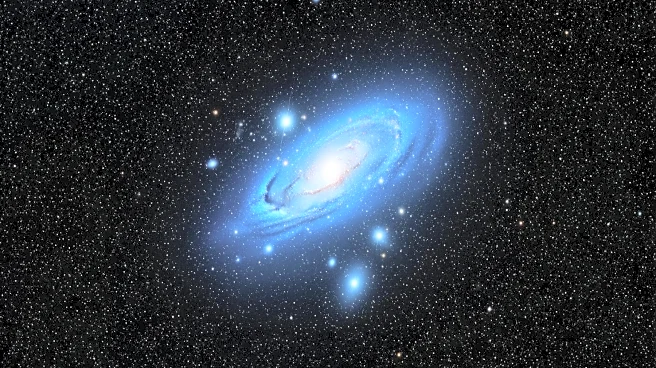
The NASA/ESA Hubble Space Telescope has captured a striking image of the blue dwarf galaxy Markarian 178 (Mrk 178), located 13 million light-years away in the constellation Ursa Major. This galaxy, smaller
than the Milky Way, is part of a group of over 1,500 Markarian galaxies, named after Armenian astrophysicist Benjamin Markarian. The image reveals a galaxy rich in young, hot stars, giving it a blue appearance, with a red hue from rare massive Wolf–Rayet stars. These stars, located in the brightest region of the galaxy, are known for shedding their atmospheres through powerful winds, contributing to the galaxy's spectrum with strong ionized hydrogen and oxygen lines. The presence of these stars suggests a recent burst of star formation, possibly triggered by a gas cloud collision or intergalactic medium disturbance.
Why It's Important?
This discovery is significant as it provides insights into the life cycle of galaxies and the processes that lead to star formation. Understanding the dynamics of dwarf galaxies like Mrk 178 can help astronomers learn more about the early universe, as these galaxies are considered building blocks of larger galaxies. The presence of Wolf–Rayet stars, which are precursors to black holes or neutron stars, offers a glimpse into the end stages of massive star evolution. This information is crucial for developing models of galaxy formation and evolution, contributing to our broader understanding of the cosmos.