






What's Happening?
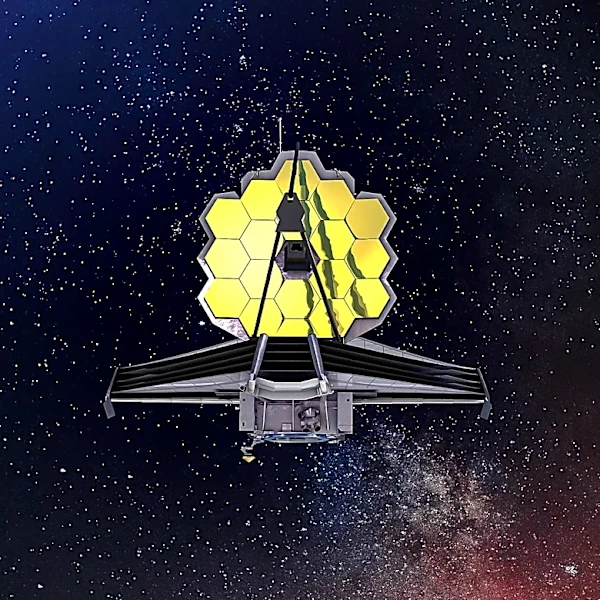
Astronomers have identified a celestial body, TOI-2155b, that challenges existing classifications between stars and brown dwarfs. Detected using NASA's TESS satellite and ground-based telescopes, TOI-2155b is nearly the size of Jupiter but 80 times more
massive, with a density almost ten times that of lead. This discovery is significant as it lies in the transitional zone where the heaviest brown dwarfs and the lightest stars are found. The object orbits the star TOI-2155, located 1,350 light-years from Earth. The classification of TOI-2155b remains uncertain, as it sits on the boundary where thermonuclear fusion might or might not occur, a key factor distinguishing stars from brown dwarfs.
Why It's Important?
The discovery of TOI-2155b is crucial for understanding the boundary conditions for thermonuclear ignition, which defines whether a celestial body becomes a star or remains a brown dwarf. This finding provides valuable data for testing theoretical models against real observations, potentially refining the criteria used to classify such objects. The implications extend to our broader understanding of star formation and the lifecycle of celestial bodies. As only a few bodies are known in this transitional zone, TOI-2155b offers a rare opportunity to study the conditions under which stars can sustain thermonuclear reactions over billions of years.
What's Next?
Further studies of TOI-2155b and similar objects are necessary to clarify the conditions that allow a star to sustain thermonuclear reactions. Astronomers aim to refine theoretical models by comparing them with actual observations of such transitional bodies. This ongoing research could lead to a more precise understanding of the mass boundary between brown dwarfs and stars, potentially impacting the classification of other celestial objects.
Beyond the Headlines
The discovery of TOI-2155b highlights the complexities involved in classifying celestial bodies and the limitations of current models. It underscores the need for continued exploration and observation to enhance our understanding of the universe. This finding also raises questions about the factors influencing the formation and evolution of stars, such as age, chemical composition, and atmospheric properties, which could lead to new insights into the dynamics of celestial bodies.