


What's Happening?
The Massachusetts Supreme Judicial Court (SJC) has unanimously upheld a preliminary injunction, blocking Quincy Mayor Thomas P. Koch's plan to install 10-foot bronze statues of Catholic saints, Saint Michael and Saint Florian, outside the city's new public
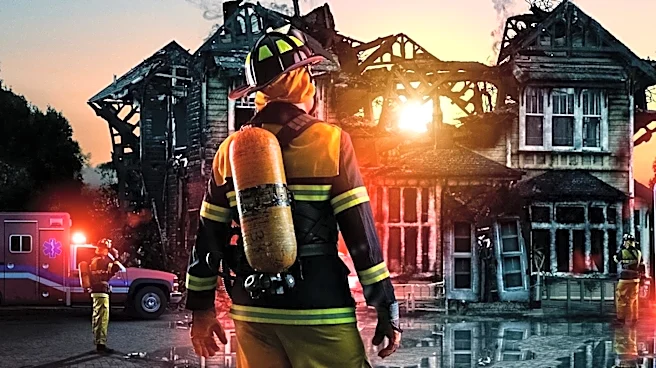
safety building. The statues, estimated to cost taxpayers $850,000, were intended to honor police officers and firefighters, as Saint Michael is the patron saint of police and Saint Florian is associated with firefighters. The SJC's decision affirms a lower court ruling that temporarily halted the installation while a lawsuit against the city proceeds. The court cited Article 3 of the state’s Declaration of Rights, adopted in 1833, which prohibits the government from advancing one religion over another. The statues, depicting Saint Michael stepping on a demon and Saint Florian towering over a burning building, were commissioned in July 2023, with the plan becoming public in 2025, sparking opposition from some religious leaders and civil libertarians.
Why It's Important?
This ruling is significant as it reinforces the principle of separation of church and state in Massachusetts, particularly concerning the use of public funds and property for religious displays. The SJC's decision highlights the constitutional mandate for governmental neutrality in religious matters, preventing the elevation of one faith over others. The case drew national attention, reflecting ongoing debates about the role of religion in government, a foundational issue addressed by the First Amendment of the U.S. Constitution. The outcome impacts how municipalities in Massachusetts can commemorate public servants, emphasizing that even if figures like Saint Michael and Saint Florian hold secular significance for some first responders, their inherently religious nature, especially when presented without broader secular context, can be perceived as governmental endorsement of a particular religion. This sets a precedent for similar cases where religious symbols are proposed for public spaces, ensuring that such displays do not violate constitutional rights.
What's Next?
The statues will remain in storage in Randolph as the lawsuit against the city of Quincy continues. Mayor Koch has vowed to continue fighting for the ability to commemorate first responders with these statues, indicating further legal proceedings are likely. The SJC's ruling is not the final word on the statues' fate, but it strongly suggests that opponents of the statues are likely to succeed in the full lawsuit. The city has already spent $761,378.75 on the design and construction of the statues. Future legal arguments will likely delve deeper into the balance between the secular and religious meanings of the saints and whether the city's actions constitute preferential treatment of a particular religion. The case may continue to attract attention from groups on both sides of the church-and-state debate, including the ACLU of Massachusetts, which represents the plaintiffs, and the Becket Fund, which represents the city and Mayor Koch.
Beyond the Headlines
The SJC's decision delves into the nuanced interpretation of religious freedom and governmental neutrality, particularly when religious figures acquire secular associations. While the court acknowledged the importance of Saint Michael and Saint Florian to many first responders, it emphasized that a secular meaning is insufficient for objects that are clearly religious, especially when they stand alone and are adorned with Catholic iconography. This ruling underscores the challenge of balancing religious expression with the constitutional imperative to avoid government endorsement of religion. It also highlights the potential for public officials' personal beliefs to intersect with their official duties, as Mayor Koch, a devout Catholic, defended the statues. The case serves as a reminder that even well-intentioned efforts to honor public servants can face legal challenges if they are perceived to blur the lines between state and religion, potentially triggering long-term shifts in how public art and memorials are conceived and approved in the U.S.