






What's Happening?
Lars Herseth, a prominent Democratic figure in South Dakota politics, passed away on Saturday at the age of 80 after a battle with cancer. Herseth, who served as a state legislator and was the Democratic nominee for governor in 1986, hailed from a family
deeply rooted in South Dakota public service. His father, Ralph Herseth, served as the state's 21st governor from 1959 to 1961, and his mother, Lorna Herseth, was South Dakota's secretary of state from 1973 to 1979. His daughter, Stephanie Herseth Sandlin, represented South Dakota in the U.S. House from 2004 to 2011 and currently serves as the president of Augustana University. Lars Herseth's political career included terms in both the state House of Representatives (1975-1986) and the state Senate (1989-1996), where he held leadership positions such as House minority leader, Senate president pro tempore, and Senate minority leader. Republican Lt. Gov. Tony Venhuizen and U.S. Senator Mike Rounds have both paid tribute to Herseth, acknowledging his dedication to public service and his ability to work across partisan lines.
Why It's Important?
The passing of Lars Herseth marks the end of an era for a family that has significantly shaped South Dakota's political landscape for generations. His career, spanning decades in both legislative chambers and a gubernatorial bid, underscores a commitment to public service that is increasingly rare. Herseth's focus on issues such as agriculture, transportation, economic development, and healthcare highlights the enduring concerns of the state. His collaborative efforts with Republican Governor Bill Janklow to preserve critical rail lines for agricultural transport demonstrate a bipartisan approach to problem-solving that benefited the state's economy. Furthermore, his advocacy for women's rights and Native American issues, as well as his opposition to a bill preventing the recognition of same-sex marriage, reflect a progressive stance on social issues that influenced policy discussions in South Dakota. His legacy serves as a reminder of the importance of dedicated public servants who prioritize the welfare of their constituents over partisan divides.
What's Next?
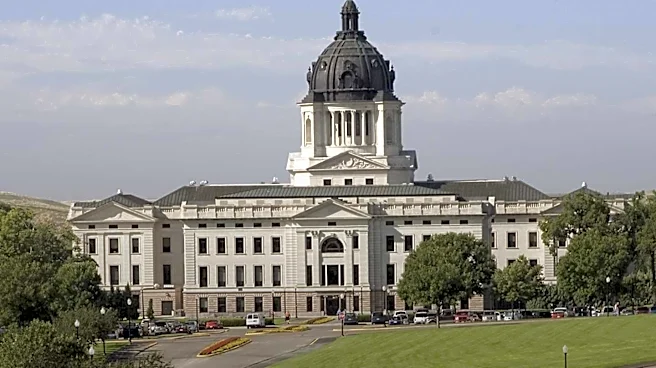
A memorial service for Lars Herseth is scheduled for 2 p.m. Central time on October 4 at the Johnson Fine Arts Center on the campus of Northern State University in Aberdeen. In recognition of his contributions, South Dakota Republican Governor Larry Rhoden has ordered flags at the state Capitol in Pierre to be flown at half-staff on the day of the memorial service. The tributes from both Republican and Democratic leaders indicate a widespread respect for Herseth's character and his impact on South Dakota. His family's continued involvement in public life, particularly through his daughter Stephanie Herseth Sandlin's role as a university president, suggests that the Herseth legacy of leadership and community engagement will persist. The event will provide an opportunity for the community and political figures to reflect on his life and contributions to the state.
Beyond the Headlines
Lars Herseth's career exemplifies a tradition of multi-generational public service within a single family, a phenomenon that has historically played a significant role in shaping regional politics in the U.S. His ability to forge bipartisan alliances, as seen in his work with Governor Janklow, highlights a model of governance that prioritizes practical solutions over ideological rigidity. In an increasingly polarized political climate, Herseth's reputation as a 'statesman and a problem solver' who was 'willing to work with anyone' offers a valuable lesson in collegiality and effective leadership. His advocacy for social justice issues, including women's rights and Native American concerns, and his stance on same-sex marriage, demonstrate a commitment to broader human rights that transcended the typical political discourse of his time. His later role as president of the American Coalition for Ethanol also underscores his continued engagement with critical economic and environmental issues affecting the agricultural sector.