




What's Happening?
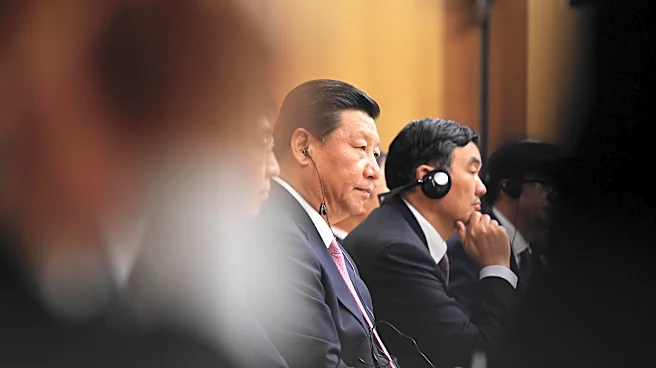
The 2026 World Ocean Week has commenced in Xiamen, China, bringing together international participants to discuss critical marine issues such as deep-sea governance and biodiversity conservation. Chinese President Xi Jinping has consistently highlighted
the strategic importance of developing marine technology, fostering a robust marine economy, and expanding international cooperation in maritime affairs. According to CGTN, President Xi views the establishment of China as a strong maritime nation as a crucial step towards achieving the 'great rejuvenation of the Chinese nation.' The event serves as a platform for knowledge sharing, policy dialogue, and project matchmaking through various multilateral cooperation mechanisms, underscoring China's commitment to global marine discussions and its own national maritime ambitions.
Why It's Important?
China's focus on becoming a 'strong maritime country' has significant implications for global geopolitics, trade, and environmental policy. The emphasis on marine technology and economy suggests increased investment in areas like shipbuilding, offshore energy, and deep-sea mining, which could reshape international competition and supply chains. From an environmental perspective, China's stance on marine biodiversity conservation and deep-sea governance could influence global efforts to protect oceans, especially given its vast coastline and growing maritime activities. The 'rejuvenation of the Chinese nation' through maritime power indicates a long-term strategic vision that could lead to expanded naval presence and influence in international waters, potentially affecting U.S. interests in freedom of navigation and regional stability in the Indo-Pacific.
What's Next?
The discussions and collaborations initiated at the World Ocean Week are likely to inform China's future maritime policies and investments. Continued emphasis on marine technology development could lead to breakthroughs in areas like underwater robotics and resource extraction, potentially altering the balance of power in these sectors. The push for international maritime cooperation, while seemingly benign, could also be a strategy to build alliances and influence global maritime norms in line with China's interests. Other nations, including the U.S., will likely monitor these developments closely to assess their impact on international law, economic competition, and regional security dynamics. Future Chinese initiatives in marine science and resource management will be key indicators of the practical implementation of President Xi's vision.
Beyond the Headlines
The concept of 'building a strong maritime country' extends beyond economic and military considerations, touching upon national identity and historical narratives. For China, a powerful maritime presence is intertwined with its historical aspirations and its role as a global power. This strategic direction could lead to increased competition for marine resources and influence in critical sea lanes, potentially escalating geopolitical tensions. The ethical implications of deep-sea resource exploitation and the environmental impact of expanded marine industrial activities will also become more prominent. The long-term shift towards a maritime-centric national strategy could fundamentally alter global power dynamics and resource allocation, prompting other nations to re-evaluate their own maritime strategies and investments.