






What's Happening?
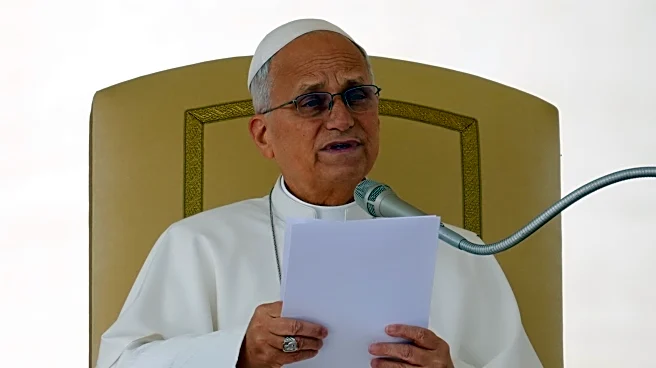
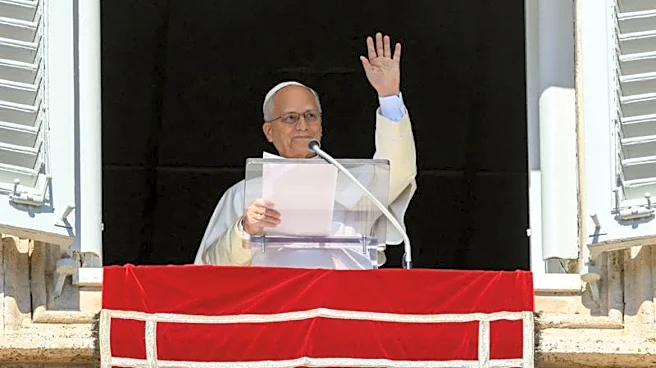
Pope Leo XIV delivered a significant speech at the Vatican on artificial intelligence, emphasizing that the future of AI is not predetermined and that machines are tools, not persons. He stressed that certain decisions, particularly those concerning life,
freedom, and the use of force, must never be delegated to AI. The Pope urged states meeting in Geneva in November to take concrete steps towards banning lethal autonomous weapons. He also highlighted that intelligent technologies should not become ends in themselves or serve only the interests of a privileged few. While agreeing with four of his five points, a commentator noted disagreement with the Pope's call for effective international institutions to govern AI, citing the UN's historical inability to act decisively and the rapid pace of technological change.
Why It's Important?
Pope Leo XIV's address on AI carries significant moral and ethical weight, influencing global discourse on technology governance. His call for a ban on lethal autonomous weapons could galvanize international efforts to regulate military AI, potentially impacting defense industries and national security strategies, including those in the U.S. His emphasis on human control over critical decisions and the warning against AI serving only a select few resonate with growing concerns about AI's societal impact, data privacy, and algorithmic bias. For U.S. tech companies, this could mean increased pressure for ethical AI development and greater accountability. The debate over the effectiveness of international institutions in governing rapidly evolving technology like AI is crucial, as it questions the feasibility of global treaties versus national or corporate-level 'bounded autonomy' solutions. This discussion affects how the U.S. approaches AI regulation, balancing innovation with ethical safeguards and international cooperation.
What's Next?
The Pope's remarks are likely to fuel ongoing discussions at international forums, such as the UN weapons convention in Geneva, regarding the regulation and potential ban of lethal autonomous weapons. While a treaty may not be immediately forthcoming, the moral authority of the Pope's statement could increase pressure on nations, including the U.S., to develop clearer policies and ethical guidelines for AI in warfare. Domestically, U.S. policymakers and tech leaders may face renewed calls to address the ethical implications of AI, particularly concerning accountability and the prevention of AI systems from operating without human oversight. The concept of 'bounded autonomy' as an alternative to international treaties for AI governance may gain traction, prompting companies to implement internal controls on AI capabilities. The broader conversation about AI's purpose and its role in society will continue to evolve, with religious and ethical leaders playing an increasingly prominent role alongside technologists and government officials.
Beyond the Headlines
The Pope's intervention in the AI debate highlights a deeper societal struggle to reconcile rapid technological advancement with fundamental human values and ethical principles. His emphasis on human dignity and the dangers of delegating critical decisions to machines touches upon profound philosophical questions about the nature of intelligence, consciousness, and moral responsibility. The challenge of governing AI also exposes the limitations of traditional international institutions, which often struggle to keep pace with technological innovation. This could lead to a paradigm shift in how global governance is approached for emerging technologies, potentially favoring more agile, multi-stakeholder approaches or even self-regulation within the tech industry, albeit with ethical frameworks. The discussion also underscores the growing importance of interdisciplinary dialogue, bringing together religious leaders, ethicists, scientists, and policymakers to shape the future of AI in a way that benefits all humanity, rather than just a privileged few.