






What's Happening?
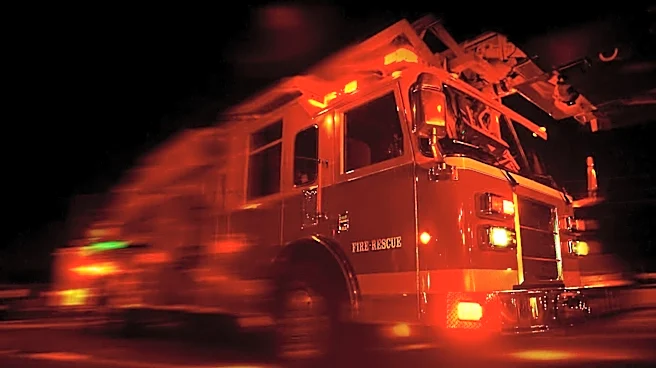
The Jonesboro Fire Department (JFD) has adopted new technology that provides in-vehicle alerts to drivers when an emergency vehicle is approaching. Utilizing the HAAS Alert system, this technology activates only when a fire truck has its lights flashing
and is responding to an emergency. The system notifies drivers as a truck approaches or is working an incident on the side of the road, giving them more time to react. Drivers of 2024 or newer Volkswagen models, and 2018 and newer Chrysler, Dodge, Jeep, or Ram vehicles will receive these notifications directly on their in-dash systems. Additionally, users of navigation apps like Apple Maps or Waze will also receive alerts. JFD Chief Marty Hamrick stated that the department has installed this system on all 10 of its frontline units, with the final installation completed approximately a month ago.
Why It's Important?
This technological advancement by the Jonesboro Fire Department is a significant step towards improving road safety for both emergency responders and the public. Modern vehicles, with their enhanced sound insulation, often make it difficult for drivers to hear approaching sirens, leading to delayed reactions and increased accident risks. By providing early, in-vehicle visual and auditory alerts, the HAAS Alert system gives drivers more time to safely move over, thereby reducing the potential for collisions and ensuring clearer paths for emergency vehicles. This initiative also supports Arkansas’ 'Move Over' laws, which mandate drivers to move a lane away from emergency vehicles, making compliance easier and more effective. The system's ability to mute in-car entertainment to deliver alerts further emphasizes its critical role in capturing driver attention during emergencies.
What's Next?
The Jonesboro Fire Department plans to continue leveraging the HAAS Alert system to enhance emergency response and public safety. While the system currently focuses on alerting drivers of approaching vehicles, JFD Chief Marty Hamrick mentioned future possibilities, including coordinating the HAAS system with the city’s traffic signals. This potential integration could allow emergency vehicles to trigger green lights along their route, optimizing response times and further reducing traffic hazards. Although this advanced coordination is still in the planning stages, it represents a significant future direction for smart city infrastructure and emergency management. The department will also likely monitor the effectiveness of the current system in reducing incidents and improving response efficiency, potentially influencing other local emergency services to adopt similar technologies.
Beyond the Headlines
The implementation of in-vehicle alert systems like HAAS Alert signifies a broader shift towards integrating smart technology into public safety infrastructure. This move addresses the evolving challenges of urban mobility and driver distraction, offering a proactive solution to a long-standing problem. Beyond immediate safety benefits, such systems contribute to the concept of 'connected vehicles' and 'smart cities,' where real-time data and communication enhance overall urban efficiency and safety. The collaboration between emergency services and automotive manufacturers, as well as navigation app developers, highlights a growing ecosystem of public-private partnerships aimed at leveraging technology for societal benefit. This trend could lead to more standardized safety features in vehicles and a more interconnected approach to emergency management nationwide.