





What's Happening?
Researchers from Curtin University have published findings in Science Advances revealing that the ancient supercontinent Gondwana was significantly larger than previously understood, potentially encompassing 80% of Earth's continental crust. By analyzing
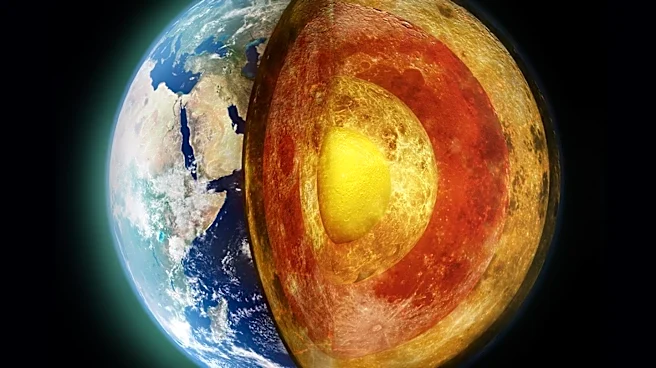
over 25,000 isotopic measurements, scientists mapped previously unrecognized fragments of ancient Gondwanan crust buried beneath younger mountain belts in Asia, Europe, and North America. This new reconstruction, termed 'Greater Gondwana,' addresses a long-standing debate about whether Gondwana met the size criteria to be classified as a true supercontinent. The study indicates that enormous pieces of this ancient landmass, which originally included Africa, South America, Antarctica, Australia, and India, have been hidden due to subsequent plate tectonic activity, stretching, detaching, and colliding with other landmasses. The isotopic analysis allowed researchers to 'see through' younger surface rocks to investigate the deeper, older continental foundations beneath them, revealing coherent zones of ancient crust in unexpected regions like the Tethyan mountain systems of Asia and parts of the Appalachians in North America.
Why It's Important?
This discovery significantly alters our understanding of Earth's ancient geography and its geological history. By reclassifying Gondwana as a true supercontinent, it implies that its assembly and subsequent tectonic reorganization were planetary-scale events rather than regional ones. The research also links the assembly of Greater Gondwana with a massive, planet-scale belt of subduction and volcanism that existed around 500 million years ago. This extensive volcanic system, stretching approximately 31,700 kilometers, is proposed to have been a long-lived source of gases like carbon dioxide and water vapor. This volatile release could have played a crucial role in supporting the transition to warmer and more humid conditions on Earth, which coincided with the dramatic increase in animal diversity during the Cambrian explosion. Understanding the scale and impact of Greater Gondwana provides new insights into the complex interplay between deep-Earth processes, climate change, and the evolution of life on our planet.
What's Next?
The findings are expected to stimulate further research into the supercontinent cycle and its profound influence on Earth's geosphere, oceans, atmosphere, and biosphere over geological timescales. Scientists will likely delve deeper into the isotopic methods used to trace buried crust, aiming to identify more hidden fragments of ancient continents and refine paleogeographic reconstructions. Future studies may also focus on the precise mechanisms through which Gondwanan tectonics and volcanism influenced global climate and the early diversification of animal life. This could involve more detailed modeling of atmospheric gas release from ancient volcanic arcs and its impact on ocean chemistry and temperature. The identification of 'Greater Gondwana' provides a new framework for understanding the interconnectedness of Earth's systems, potentially leading to a re-evaluation of existing theories on continental drift, climate evolution, and the drivers of major evolutionary events.
Beyond the Headlines
The concept of 'Greater Gondwana' extends beyond mere geological mapping; it highlights the dynamic and interconnected nature of Earth's systems over vast periods. The idea that a single supercontinent could have covered 80% of the continental crust underscores the immense scale of geological forces that have shaped our planet. This research also emphasizes the power of isotopic analysis as a tool to uncover hidden geological histories, allowing scientists to reconstruct events that occurred hundreds of millions of years ago. The proposed link between massive volcanic activity around Greater Gondwana and the Cambrian explosion suggests a profound connection between deep-Earth processes and the emergence of complex life. This perspective encourages a holistic view of Earth's history, where tectonic movements, atmospheric composition, and biological evolution are intricately intertwined, offering a deeper appreciation for the planet's long-term geological and biological evolution.