



What's Happening?
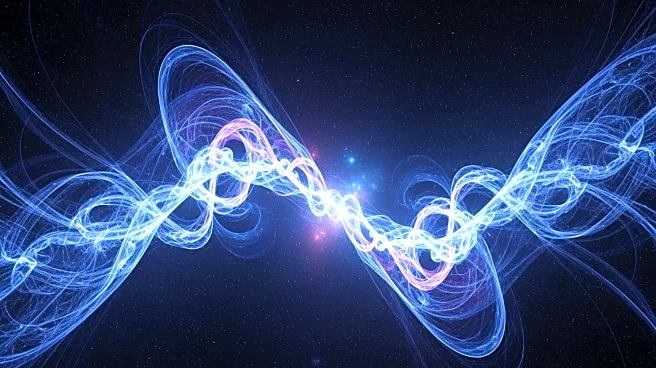
A team of physicists in Japan has proposed a new theory involving 'cosmic knots' to explain the existence of the universe. Published in Physical Review Letters, the study suggests that these knotted structures could have formed in the early universe,
influencing the matter-antimatter imbalance that led to the universe's current state. The knots, formed from a combination of symmetries, could have dominated the universe's energy at one point, eventually decaying in a way that favored matter over antimatter. This process could be detectable through gravitational waves, offering a potential avenue for future experimental verification.
Why It's Important?
This theoretical breakthrough addresses one of the most fundamental questions in physics: why the universe is composed of matter rather than antimatter. The proposed model not only offers a potential explanation for this imbalance but also integrates solutions to other major mysteries, such as the origins of neutrino masses and dark matter. If validated, this theory could significantly advance our understanding of the universe's formation and the fundamental forces at play, potentially leading to new insights in particle physics and cosmology.
What's Next?
Future research will focus on refining the theoretical models and simulations to better predict the formation and decay of these cosmic knots. Upcoming gravitational-wave observatories, such as LISA and DECIGO, may be able to detect the gravitational wave patterns predicted by this theory, providing empirical evidence to support or refute the model. The continued exploration of these concepts could lead to a deeper understanding of the universe's origins and the fundamental laws governing it.