

What's Happening?
Senator Adam Schiff (D-Calif.) has voiced significant concerns regarding the potential deployment of U.S. Immigration and Customs Enforcement (ICE) or military personnel to polling places during the upcoming November elections. Schiff highlighted that
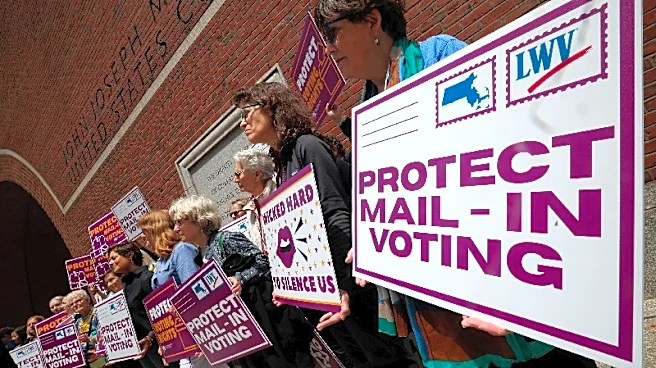
some individuals associated with President Trump, such as Steve Bannon, have openly suggested sending ICE or Border Patrol agents to ballot locations. Schiff believes such actions are intended to discourage Latino citizens from voting due to fear. He noted that federal law prohibits troops from being present at election sites. However, past deployments of ICE agents to airports and an FBI raid on an election office in Fulton County, Georgia, have fueled his apprehension. Schiff argues that the Trump administration's success in the midterm elections may depend on suppressing voter turnout. He also expressed worry about broader attacks on voting, including a case before the Supreme Court that could significantly impact absentee voting, potentially leading to chaos.
Why It's Important?
Senator Schiff's concerns underscore a critical issue regarding voter intimidation and the integrity of the electoral process. The potential presence of armed federal agents or military personnel at polling places could create an environment of fear, particularly among minority communities, and deter eligible citizens from exercising their right to vote. This could lead to significant voter suppression, undermining the democratic principle of free and fair elections. Such actions, if implemented, would likely face immediate legal challenges, as federal law explicitly prohibits military interference in elections. The discussion also highlights the ongoing tension between ensuring election security and protecting voter access, with critics arguing that claims of widespread fraud are often used to justify measures that disproportionately affect certain demographics. The broader implications involve public trust in electoral institutions and the potential for increased polarization around voting rights.
What's Next?
As the November elections draw closer, the debate over election security measures and potential voter intimidation tactics is expected to intensify. Voting rights organizations and civil liberties groups will likely remain vigilant, monitoring any attempts to deploy federal agents or military personnel to polling places. Legal challenges are almost certain to arise if such actions are initiated, citing federal laws that prohibit interference with elections. The Supreme Court's decision on the ongoing case concerning absentee voting will also be a critical factor, as it could significantly alter voting procedures nationwide. Political leaders and advocacy groups will continue to mobilize voters and educate them about their rights, while also preparing to counter any efforts perceived as voter suppression. The rhetoric from figures like Steve Bannon will likely continue to fuel these concerns, keeping the issue at the forefront of political discourse.
Beyond the Headlines
The discussion surrounding ICE or military presence at polling places delves into the fundamental right to vote and the role of federal agencies in domestic affairs. The deployment of armed personnel to monitor elections could be seen as a move towards militarizing the electoral process, which has profound implications for civil liberties and democratic norms. It raises questions about the balance of power between federal authority and individual voting rights, and whether such actions are genuinely aimed at security or at influencing election outcomes. The historical context of voter suppression, particularly against minority groups, adds another layer of complexity, as these concerns often disproportionately affect communities that have historically faced barriers to voting. This situation could lead to a re-evaluation of federal statutes governing election conduct and potentially spark broader conversations about the protection of democratic institutions against perceived threats, both internal and external.