



What's Happening?
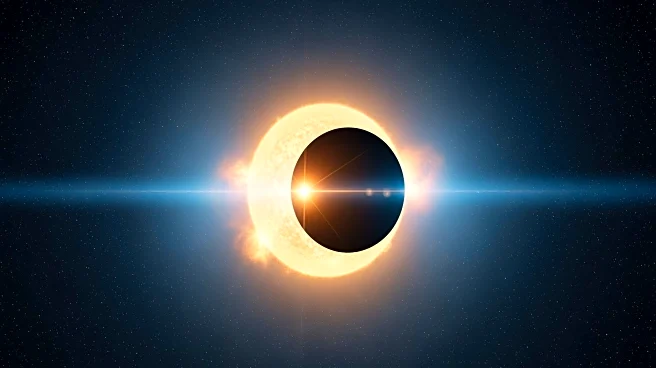
Astronomers are investigating a mysterious dimming event of a distant star, ASASSN-24fw, located 3,200 light-years away in the Monoceros constellation. The star's brightness was reduced by 97% over 200 days, one of the longest and most extreme dimming events
observed. Scientists suspect the cause to be a brown dwarf or a massive exoplanet with a vast ring system. This rare event provides an opportunity to study complex celestial systems and understand the dynamics of such dimming phenomena.
Why It's Important?
The investigation into ASASSN-24fw's dimming event is significant for advancing our understanding of celestial mechanics and the formation of planetary systems. Discovering the nature of the object causing the dimming could provide insights into the characteristics of brown dwarfs and massive exoplanets. This research may also inform future astronomical studies and the search for similar phenomena, contributing to our knowledge of the universe's diversity and complexity.
What's Next?
Astronomers plan to gather more data using the Very Large Telescope and the James Webb Space Telescope to determine the characteristics of ASASSN-24fw and its surrounding system. Further observations will help confirm the nature of the dimming object and its impact on the star. The team anticipates another dimming event in 42 to 43 years, providing a future opportunity for detailed study.