




What's Happening?
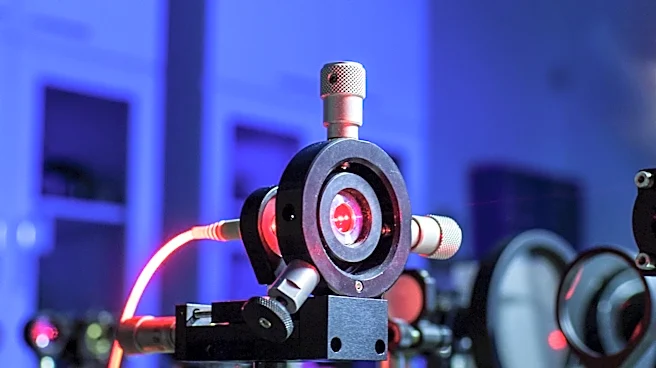
Students and Associate Professor Jie Qiao at the Rochester Institute of Technology (RIT) have successfully developed a method for deterministically figuring and finishing freeform optical surfaces using a femtosecond laser. This breakthrough, detailed
in Optics Express with Muhammed Akif Qadeer as lead author and Noah Sanderson as second author, stems from over a decade of research into how ultrashort laser pulses can precisely shape and smooth semiconductor and optical materials. The new noncontact process eliminates the need for a separate polishing step, potentially revolutionizing the manufacturing of advanced optical components. Freeform optics are crucial for applications in augmented and virtual reality, space telescopes, vehicle headlights, and medical equipment. Professor Qiao's patented technology has already been licensed to industry, indicating its commercial viability and impact.
Why It's Important?
This development holds significant importance for U.S. industries reliant on advanced optics, including defense, aerospace, consumer electronics, and healthcare. The ability to precisely fabricate freeform optics more efficiently and without traditional polishing steps can lead to faster production cycles, reduced manufacturing costs, and the creation of more sophisticated optical systems. This innovation could give U.S. companies a competitive edge in markets where high-precision optics are critical. Furthermore, the involvement of RIT students in this research highlights the role of academic institutions in fostering innovation and developing a skilled workforce for the growing laser technology sector, particularly in regions like Rochester/Finger Lakes, which is supported by initiatives like the National Science Foundation STELLAR Engine.
What's Next?
Professor Qiao's research continues to attract interest from companies, suggesting potential for further industry collaborations and licensing agreements. The STELLAR Laser and Optics Laboratory at RIT, directed by Qiao, is expected to support workforce development in the Rochester and Finger Lakes region, ensuring a pipeline of skilled professionals for the optics and photonics industry. Continued advancements in this femtosecond-laser fabrication technology could lead to its broader adoption across various manufacturing sectors, potentially setting new standards for optical component production. Future research may focus on expanding the range of materials that can be processed and further optimizing the technique for even greater precision and efficiency.
Beyond the Headlines
The long-term implications of this research extend beyond immediate manufacturing benefits. The ability to create highly customized and efficient freeform optics could accelerate innovation in fields such as medical imaging, enabling more accurate diagnostics, and in augmented reality, leading to more immersive and realistic user experiences. Ethically, the precision and efficiency of this technology could reduce waste in manufacturing processes, contributing to more sustainable production methods. The success of this project also underscores the value of sustained, long-term investment in fundamental scientific research and the critical role of mentorship in developing the next generation of scientists and engineers, as highlighted by Professor Qiao's dedication to her students.