






What's Happening?
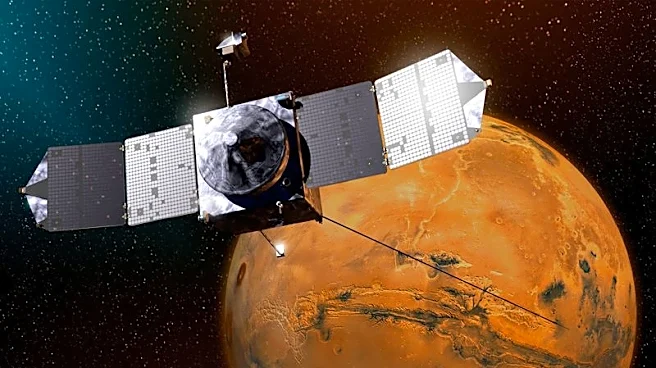
NASA has concluded the mission of the MAVEN orbiter after losing contact with the spacecraft in December 2025. MAVEN, which stands for Mars Atmosphere and Volatile Evolution, was launched in 2013 to study the Martian atmosphere and its interaction with solar
wind. Despite attempts to reset the spacecraft's systems, communication could not be reestablished. The orbiter provided valuable data on atmospheric escape processes, such as 'sputtering,' which have implications for understanding Mars' climate history and atmospheric evolution. The mission, initially planned for one year, was extended multiple times due to its success in gathering critical scientific data.
Why It's Important?
MAVEN's mission has been instrumental in advancing our understanding of Mars' atmospheric dynamics and its transition from a potentially habitable environment to its current state. The data collected has implications for planetary science, offering insights into atmospheric processes that could affect other planets and exoplanets. The loss of MAVEN underscores the challenges of maintaining long-term space missions and the need for robust systems to ensure mission success. The findings from MAVEN will continue to inform future Mars exploration efforts, including potential human missions to the planet.
What's Next?
NASA is investigating the cause of MAVEN's communication failure to glean insights that could benefit future missions. The agency has set up an anomaly review board to analyze the situation and identify potential improvements for spacecraft design and operation. Meanwhile, other Mars orbiters will continue to support ongoing missions and relay data from surface rovers. The lessons learned from MAVEN's mission will be applied to enhance the reliability and effectiveness of future Mars exploration initiatives, contributing to the broader goal of human exploration of the Red Planet.