








What's Happening?
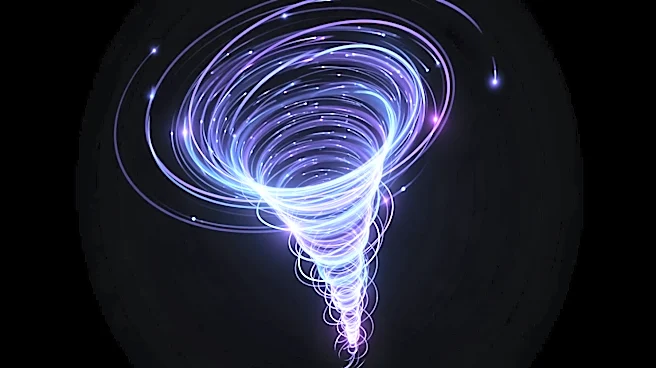
Scientists from the University of Warsaw, the Military University of Technology, and the Institut Pascal CNRS at Université Clermont Auvergne have developed a new technology called 'optical tornadoes.' This innovation involves creating swirling light
structures within a small framework, which could revolutionize the way miniature light sources are built. The technology combines various fields of physics, including quantum mechanics and materials engineering, to produce structured light states that are beneficial for quantum communication and controlling microscopic objects. The researchers utilized liquid crystals to form special defects known as torons, which act as microscopic traps for light. This approach simplifies the production of complex light structures, potentially leading to more scalable photonic devices.
Why It's Important?
The development of optical tornado technology is significant as it offers a simpler and more scalable method for creating photonic devices, which are crucial for optical communication and quantum technologies. By using self-organizing materials like liquid crystals, the technology reduces the need for complex nanostructures, making it more accessible and cost-effective. This advancement could enhance the efficiency and stability of quantum communication systems, which are vital for secure data transmission and advanced computing applications. The ability to produce stable light vortices in the ground state also facilitates easier energy accumulation, potentially leading to more efficient laser technologies.
What's Next?
The researchers plan to further explore the applications of optical tornado technology in quantum communication and photonic devices. Future studies may focus on optimizing the control of light properties using external electric voltages and enhancing the synthetic magnetic field effects. The technology's potential for simplifying the production of complex light structures could lead to advancements in various fields, including telecommunications and computing. As the technology matures, it may attract interest from industries looking to improve data transmission and processing capabilities.
Beyond the Headlines
The optical tornado technology represents a shift towards using self-organizing materials in photonics, which could have broader implications for material science and engineering. By drawing inspiration from advanced theories involving vectorial charges, the technology challenges traditional approaches to light manipulation, potentially leading to new insights into the behavior of photons and their interactions. This could pave the way for novel applications in areas such as quantum computing and advanced imaging techniques.