




What's Happening?
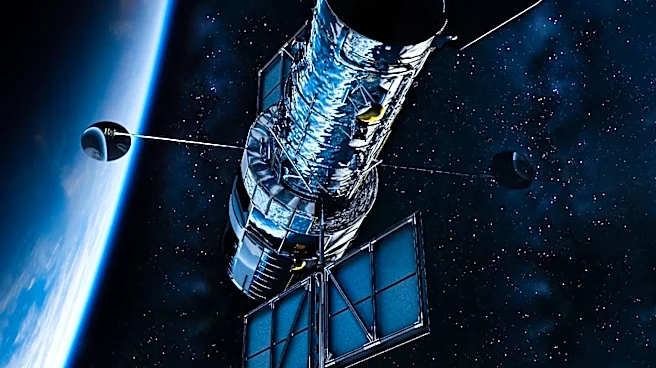
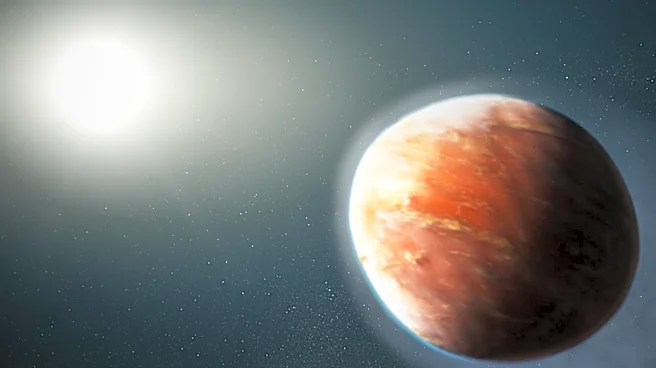
Scientists have directly confirmed the presence of dynamic water clouds on WISE 0855, a celestial object located 7.5 light-years from Earth. Using the James Webb Space Telescope (JWST), a team led by Brittany Miles, an assistant astronomer at the University
of Arizona’s Steward Observatory, observed the brown dwarf for 11 hours, capturing a spectrum every 15 minutes. This detailed time-series portrait revealed that the water clouds on WISE 0855 change thickness over time, indicating the presence of real, dynamic weather. The JWST observations also detected rhythmic signals from gases like carbon monoxide and phosphine, which are pushed into the atmosphere by convection, similar to Jupiter's atmosphere. This marks the first time researchers have been able to distinguish the effects of clouds, chemistry, and temperature on such a distant world, moving beyond previous photometric data that blended these elements.
Why It's Important?
This discovery is significant because it provides direct evidence that weather phenomena, previously thought to be unique or rare, are occurring on celestial bodies far beyond our solar system. The confirmation of changing water clouds on WISE 0855 suggests that the physical and chemical processes governing atmospheric dynamics are universal, applying across different types of cosmic objects. This understanding can help scientists decode the atmospheres of distant exoplanets, including those that might be candidates for habitability. The brown dwarf, with a mass approximately twice that of Jupiter, blurs the distinction between planets and stars, offering a unique laboratory to study atmospheric physics. The findings challenge previous assumptions about the uniqueness of Earth's weather and expand our comprehension of the diverse and active environments in the universe.
What's Next?
With more baseline observations, Miles and her team plan to delve deeper into the planet's rotation and atmospheric dynamics. The universality of these observed weather patterns implies that the same rules of physics and chemistry could be applied to understand gas-giant exoplanets orbiting other stars. This will enable the JWST to continue its mission of decoding the skies of distant exoplanets, potentially identifying worlds with conditions suitable for life. The ongoing research will build upon decades of theoretical work and atmospheric models, particularly those benchmarked against Jupiter, to refine our understanding of these complex extraterrestrial environments. Future studies will likely focus on long-term monitoring to observe further changes and gather more comprehensive data on the atmospheric composition and behavior of WISE 0855 and similar objects.
Beyond the Headlines
The confirmation of dynamic weather on WISE 0855 has profound implications for astrobiology and our understanding of planetary formation. It suggests that the conditions necessary for complex atmospheric processes are not exclusive to our solar system, broadening the scope of where life might potentially arise or where similar planetary systems could exist. This discovery also highlights the advanced capabilities of the James Webb Space Telescope, demonstrating its power to provide unprecedented insights into exoplanetary atmospheres. Ethically, it reinforces the idea that Earth is not an isolated anomaly in the cosmos, encouraging a more expansive view of our place in the universe. Culturally, it fuels human curiosity and the drive for exploration, pushing the boundaries of scientific inquiry into the vast unknown.