



What's Happening?
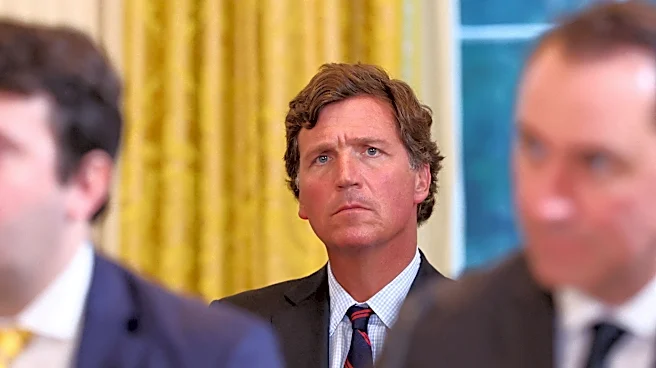
Conservative host Tucker Carlson has publicly rejected Republican Senate candidate Mike Rogers, stating he 'wouldn’t vote for Mike Rogers at gunpoint.' Carlson characterized Rogers, a strong supporter of Israel and former House Intelligence Committee
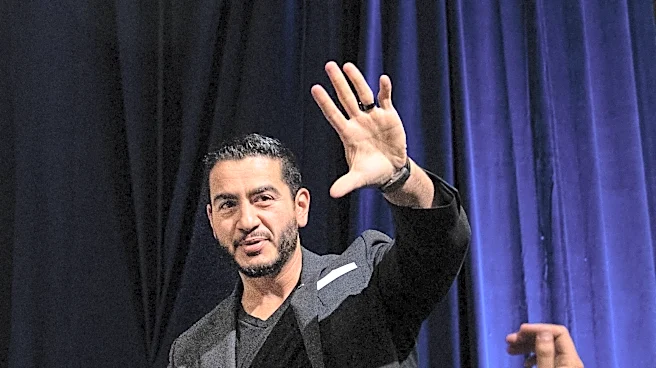
chairman, as 'basically a tool of Israel and the intelligence agencies.' This stance emerged during a discussion on his show with Breaking Points co-host Saagar Enjeti, where they discussed the Michigan Senate race. Conversely, Carlson expressed support for Democrat Abdul El-Sayed, describing his agenda as 'literally Trumpian' due to its break from the foreign-policy establishment. El-Sayed, who won his Democratic primary despite significant opposition spending, has pledged to oppose continued U.S. military aid to Israel. This intervention by Carlson highlights a shifting political landscape where traditional party lines are being blurred by issues like U.S. foreign policy and support for Israel.
Why It's Important?
Carlson's comments are significant as they demonstrate a growing ideological divide within the conservative movement, particularly concerning foreign policy and the U.S. relationship with Israel. His rejection of a mainstream Republican candidate like Mike Rogers, coupled with his praise for a progressive Democrat like Abdul El-Sayed, signals a potential realignment of political allegiances based on specific issues rather than strict party loyalty. This could impact future elections by encouraging voters to prioritize individual policy stances over party affiliation. For the Republican Party, this could indicate a challenge in maintaining a unified front, especially on foreign policy matters. For Democrats, it might open avenues for unexpected cross-party support on issues that resonate with a broader, non-traditional base. The influence of prominent media figures like Carlson in shaping voter sentiment, even against established party candidates, underscores the evolving dynamics of political discourse in the U.S.
What's Next?
The immediate consequence of Carlson's statements could be increased scrutiny on Mike Rogers' campaign and his foreign policy positions, potentially impacting his standing among conservative voters who align with Carlson's views. Conversely, Abdul El-Sayed might see a boost in visibility and an expansion of his appeal beyond traditional Democratic voters, attracting those who share Carlson's skepticism of the foreign policy establishment. This could lead to a more complex and unpredictable Michigan Senate race, where traditional party endorsements may hold less sway. Other political figures and media personalities might also weigh in, further polarizing or diversifying the debate. The situation could also prompt other candidates to re-evaluate their foreign policy platforms to address the concerns raised by figures like Carlson, particularly regarding U.S. aid to Israel and the role of intelligence agencies.
Beyond the Headlines
This development points to a deeper trend of ideological fragmentation within both major U.S. political parties, driven by issues that transcend conventional left-right divides. The opposition to U.S. support for Israel and distrust of Washington's foreign policy establishment are increasingly becoming cross-cutting issues, uniting segments of the far-left and far-right. This phenomenon challenges the traditional two-party system and could lead to the formation of new, issue-specific coalitions. It also highlights the significant power of independent media personalities to influence political narratives and voter behavior, potentially more so than established party structures. The long-term implication could be a more fluid and less predictable political landscape, where candidates are judged more on their individual policy positions on key issues rather than solely on their party affiliation, leading to a redefinition of what it means to be 'conservative' or 'liberal' in the U.S.