



What's Happening?
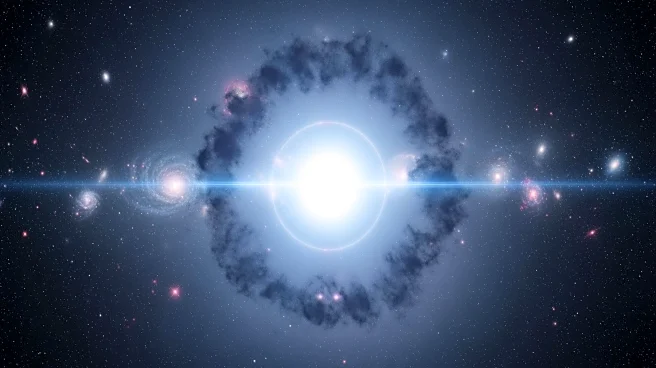
Scientists are exploring the concept of 'dark stars' as a potential explanation for several mysteries observed in the early universe by the James Webb Space Telescope (JWST). These hypothetical objects, powered by dark matter annihilation rather than
nuclear fusion, could account for the unexpected abundance of supermassive black holes, the existence of 'blue monster' galaxies, and the mysterious 'little red dots' observed in the early cosmos. Dark stars are theorized to have formed before ordinary stars, potentially serving as massive seeds for supermassive black holes, thus explaining their rapid formation shortly after the Big Bang.
Why It's Important?
The hypothesis of dark stars offers a unified explanation for several puzzling observations made by the JWST, challenging existing models of cosmic evolution. If proven, this theory could revolutionize our understanding of the early universe and the role of dark matter in star formation. The potential existence of dark stars would also provide insights into the conditions that led to the formation of supermassive black holes and the structure of early galaxies. This research underscores the importance of continued exploration and observation to refine our models of the universe's history.