




What's Happening?
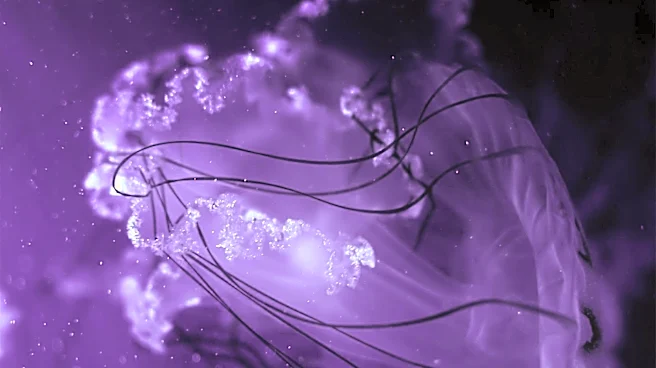
The Turritopsis dohrnii, commonly known as the 'immortal jellyfish,' is a tiny marine creature capable of reversing its aging process. When faced with stress, injury, or old age, it undergoes a process called transdifferentiation, where its adult cells
revert to an earlier, polyp stage, effectively restarting its life cycle. This unique biological ability means it does not die of natural causes, though it can still succumb to predators, disease, or physical injury. Originally from the Mediterranean, this jellyfish has now been observed in oceans worldwide. Its global spread is largely attributed to cargo ships, which inadvertently transport the jellyfish in their ballast water, allowing it to colonize new environments across international shipping routes. Scientists have extensively studied this phenomenon in laboratory settings, confirming its ability to repeatedly revert to its juvenile form without any apparent limit.
Why It's Important?
The global proliferation of the Turritopsis dohrnii carries significant implications for marine ecosystems and scientific research. Its ability to effectively 'cheat death' by reverting to a younger state makes it a subject of intense interest in aging research and regenerative medicine. Understanding the cellular mechanisms behind transdifferentiation could offer breakthroughs in human anti-aging treatments and tissue regeneration, potentially revolutionizing medical science. However, its unchecked spread, facilitated by human maritime activities, also poses an ecological concern. As an invasive species, its presence in new habitats could disrupt local marine food webs and ecosystems, potentially outcompeting native species or altering biodiversity. The jellyfish's resilience and unique life cycle make it a powerful, albeit tiny, force in the ongoing study of biological immortality and environmental adaptation.
What's Next?
Researchers will continue to investigate the cellular and genetic mechanisms that enable the Turritopsis dohrnii to undergo transdifferentiation. The focus will likely be on identifying specific genes or proteins responsible for this remarkable biological feat, with the aim of understanding if these processes can be replicated or adapted for human benefit, particularly in the fields of regenerative medicine and anti-aging therapies. Concurrently, marine biologists will monitor the jellyfish's spread and its ecological impact on various ocean environments. Efforts may also be directed towards understanding how to mitigate the unintentional transport of invasive species via ballast water, potentially leading to new regulations or technologies for maritime shipping. The ongoing study of this creature could also inspire new approaches to understanding fundamental biological processes of life and death.
Beyond the Headlines
The existence of the 'immortal jellyfish' challenges fundamental biological assumptions about aging and mortality, prompting deeper philosophical and scientific questions about the limits of life. Its ability to reset its biological clock offers a tangible example of a creature that has bypassed the typical constraints of senescence, a process long considered universal. This phenomenon pushes the boundaries of what is understood about cellular plasticity and organismal longevity. Ethically, if the mechanisms of its 'immortality' could ever be partially translated to humans, it would raise profound societal questions about overpopulation, resource allocation, and the very definition of human life and purpose. Culturally, it resonates with ancient myths of eternal youth, bringing a scientific dimension to age-old human aspirations for immortality, albeit in a tiny, gelatinous form. The jellyfish serves as a living testament to the extraordinary diversity and adaptability of life on Earth.