





What's Happening?
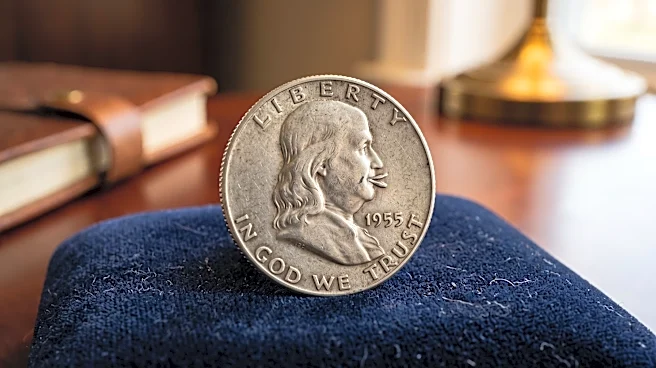
A rare 1955 Franklin half dollar, known as the 'Bugs Bunny' variety, recently sold for $9,394.88 at GreatCollections. This coin is distinguished by a minting error that created raised projections resembling buck teeth on Benjamin Franklin's portrait.
The error occurred due to a 'die clash,' where the obverse and reverse dies collided without a planchet between them, causing portions of the eagle's wing feathers from the reverse die to impress upon the obverse die near Franklin's mouth. The Franklin half dollar series itself has a notable history, initiated by Nellie Tayloe Ross, the first female Director of the United States Mint, who championed placing Benjamin Franklin on circulating coinage. Despite initial resistance from the Commission of Fine Arts regarding the design, particularly the small eagle and the cracked Liberty Bell motif, Treasury Secretary John W. Snyder supported Ross, and the coin entered nationwide distribution on April 30, 1948. The 1955 Philadelphia Mint production of Franklin half dollars was the lowest annual mintage for the series, with 2,498,181 coins produced.
Why It's Important?
The 'Bugs Bunny' Franklin half dollar highlights the significant impact of minting errors and historical context on the value and collectibility of U.S. coinage. This specific variety, while a subtle die clash, gained widespread recognition due to its memorable nickname and the growing interest in coin collecting during the 1950s, coinciding with the popularity of the Bugs Bunny character. The story also underscores the influence of key figures like Nellie Tayloe Ross in shaping U.S. currency designs and overcoming institutional resistance. The coin's value is further amplified by its condition and specific features, such as 'Full Bell Lines' (FBL) on the Liberty Bell, which can dramatically increase its market price. This demonstrates how nuanced details and historical narratives contribute to the numismatic market, attracting collectors and investors who seek out unique and well-preserved specimens. The short lifespan of the Franklin half dollar, replaced by the Kennedy half dollar after President John F. Kennedy's assassination, adds another layer of historical significance to the series.
What's Next?
The market for rare U.S. coins, particularly those with unique minting errors or historical significance, is likely to continue attracting strong interest from collectors and investors. As demonstrated by the sale of the 'Bugs Bunny' Franklin half dollar, exceptional specimens with certified variety attribution and high-grade preservation can command significant prices. Collectors will continue to seek out these specific varieties, such as the FS-401 designation for the 'Bugs Bunny' error, and prioritize features like 'Full Bell Lines' which are critical for determining a coin's value. The ongoing demand for such historical artifacts ensures that future auctions and sales of similar rare U.S. coinage will likely see competitive bidding, further solidifying their status as valuable collectibles. The U.S. Mint's historical output, including its errors and design controversies, will remain a rich area for numismatic study and collection.
Beyond the Headlines
The 'Bugs Bunny' Franklin half dollar transcends its monetary value, serving as a tangible link to American history and the evolution of its currency. It illustrates how seemingly minor production anomalies can become cultural touchstones, reflecting broader societal trends like the rise of popular cartoon characters. The coin's journey from a contested design to a highly sought-after collectible also sheds light on the intricate processes and human elements involved in currency production, from the vision of Mint Directors to the meticulous work of engravers. Furthermore, the abrupt end of the Franklin half dollar series due to a national tragedy—the assassination of President John F. Kennedy—highlights how historical events can directly influence the physical symbols of a nation. This coin, therefore, is not just a piece of metal but a narrative artifact, embodying stories of innovation, controversy, popular culture, and national memory within its small form.