
What's Happening?
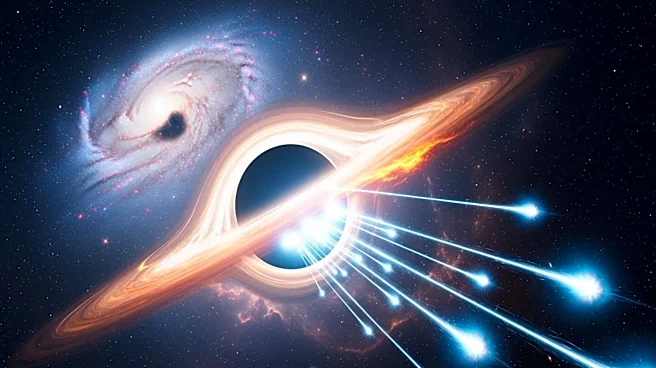
Researchers at the University of California, Riverside, have proposed a new theory suggesting that the decay of dark matter could have accelerated the formation of supermassive black holes in the early
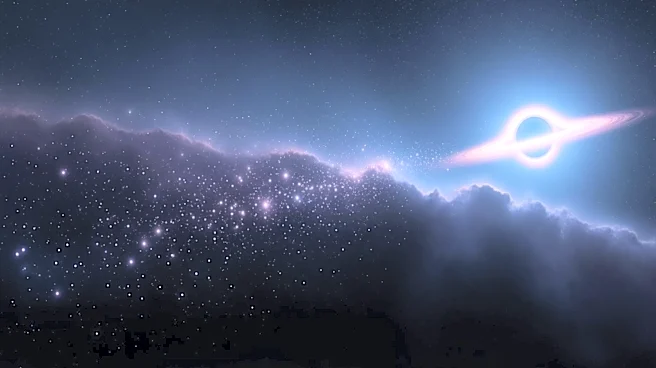
universe. This theory is based on observations from the James Webb Space Telescope, which detected supermassive black holes from a time when the universe was less than a billion years old. The researchers suggest that the energy released by the decay of dark matter particles, within a hypothetical mass range of 24 to 27 electronvolts, could have triggered the direct collapse of primordial gas clouds into black holes. This process bypasses the star formation stage, which is traditionally thought to be necessary for black hole formation. The study highlights the potential role of dark matter as an energy source that could have influenced the early universe's structure.
Why It's Important?
The significance of this research lies in its potential to reshape our understanding of cosmic evolution and the role of dark matter. If dark matter decay indeed contributed to the rapid formation of supermassive black holes, it could challenge existing models of galaxy formation and evolution. This theory could also provide insights into the nature of dark matter, which remains one of the most elusive components of the universe. Understanding these processes could have implications for astrophysics and cosmology, potentially influencing future research directions and observational strategies.
What's Next?
Further research and observations are needed to validate this theory. The James Webb Space Telescope and other astronomical instruments will continue to play a crucial role in gathering data on early universe phenomena. Researchers may also explore the implications of dark matter decay in other cosmic contexts, potentially leading to new discoveries about the universe's fundamental properties. Collaboration between theoretical and observational astrophysicists will be essential to test and refine these ideas.