



What's Happening?
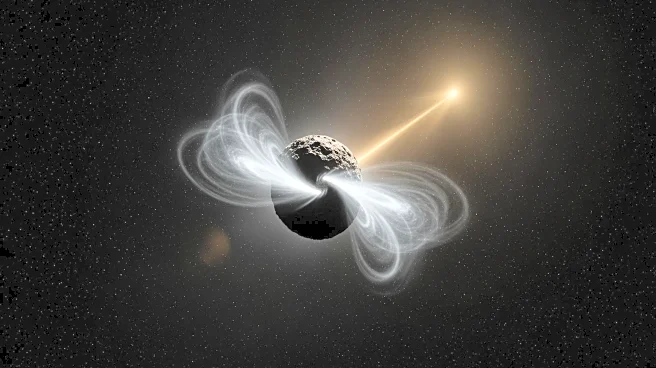
Comet 3I/ATLAS, an interstellar object, is currently being observed as it exits the solar system. This comet, only the third confirmed interstellar object observed, has captured the attention of astronomers due to its unique features, including a rare
'anti-tail' that appears to point toward the Sun and jets that exhibit a wobbling motion. These jets shift position with a cycle of about 7 hours and 45 minutes, suggesting the comet's nucleus rotates approximately every 15.5 hours. The comet was first reported in July 2025 by the ATLAS survey telescope in Chile and has been closely monitored by NASA and ESA. Despite its proximity to the Sun, 3I/ATLAS poses no threat to Earth, remaining at a safe distance even at its closest approach.
Why It's Important?
The observation of Comet 3I/ATLAS provides a rare opportunity to study material from outside our solar system, offering insights into the formation of icy bodies in other planetary systems. The comet's unique features, such as the anti-tail and wobbling jets, allow scientists to compare its behavior with that of solar system comets, enhancing our understanding of cometary physics. The data collected could have significant implications for our knowledge of interstellar objects and the processes that govern their formation and evolution. Additionally, the comprehensive observation campaign, involving multiple NASA missions and international collaborations, underscores the importance of global scientific efforts in advancing space research.
What's Next?
As Comet 3I/ATLAS continues its journey out of the solar system, it is expected to pass by Jupiter in March 2026. This encounter will provide further opportunities for observation, potentially offering new insights into the comet's structure and behavior. Scientists will continue to monitor the comet using various telescopes and spacecraft, aiming to gather as much data as possible before it becomes too faint to study. The upcoming proximity to Jupiter may also allow for unique observational angles, contributing to a more comprehensive understanding of this interstellar visitor.