





What's Happening?
Congressman Adriano Espaillat (D-13) attended a commemoration in Belle Harbor, Queens, to honor the 265 victims of American Airlines Flight 587, which crashed on November 12, 2001. The flight was en route to the Dominican Republic from John F. Kennedy
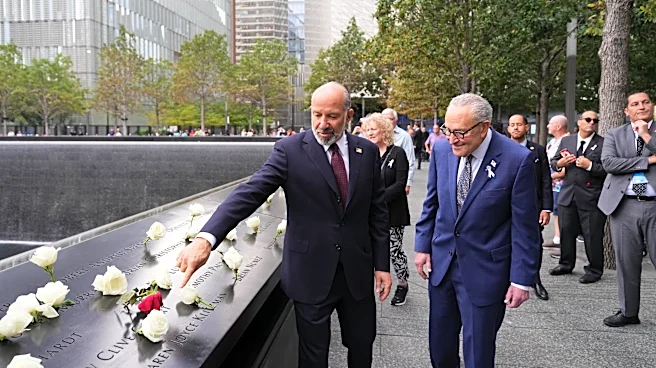
Airport. Of the 265 fatalities, 175 were of Dominican origin. Congressman Espaillat, the first U.S. Congressman of Dominican descent, spoke at the monument erected at the crash site, emphasizing solidarity with the victims' families and the enduring memory of those lost. He highlighted his role in promoting public funding for the construction of the memorial, which was designed by Dominican artist Freddy Rodríguez. The monument features a curved wall of Canadian vermillion granite blocks with various openings and a view of the sea, inscribed with a line from Dominican poet Pedro Mir. Espaillat also recalled the Flight 587 Memorial Scholarship program, established in 2003 through a state law, which has enabled dozens of orphaned children and other affected family members to pursue higher education in public and private universities.
Why It's Important?
This commemoration holds significant importance for several reasons. Firstly, it serves as a poignant reminder of a tragic event in U.S. aviation history, considered the second deadliest air accident in the nation, occurring just two months after the September 11 attacks. For the Dominican-American community, particularly in New York, the event is deeply personal, given the high number of Dominican victims. Congressman Espaillat's consistent presence and advocacy underscore the ongoing need for remembrance and support for the affected families. The Flight 587 Memorial Scholarship program is a critical initiative, providing tangible support for the educational future of those impacted by the tragedy. This program exemplifies how legislative action can translate into long-term community assistance, ensuring that the legacy of the victims includes opportunities for their descendants. The memorial itself, a public space for reflection, reinforces community bonds and provides a permanent place for grieving and remembrance, highlighting the role of public art in healing and collective memory.
What's Next?
The annual commemoration of American Airlines Flight 587 is expected to continue, serving as a recurring event for remembrance and community gathering in Belle Harbor, Queens. The Flight 587 Memorial Scholarship program will likely persist in its mission to support the higher education of affected individuals, ensuring that the educational opportunities created by the 2003 state law remain available. Congressman Espaillat and other community leaders will likely continue to advocate for the needs of the victims' families and the broader Dominican-American community, potentially through ongoing support for the memorial and related initiatives. The event also serves as a reminder of the importance of aviation safety and the continuous efforts by bodies like the National Transportation Safety Board (NTSB) to investigate accidents and implement measures to prevent future tragedies. The NTSB attributed the 2001 crash to excessive rudder pedal inputs by the first officer in response to wake turbulence, leading to subsequent changes in pilot training and aircraft design.
Beyond the Headlines
The commemoration of American Airlines Flight 587 transcends a simple act of remembrance; it highlights the complex interplay of grief, community resilience, and political advocacy in the aftermath of a major tragedy. The significant number of Dominican victims underscores the transnational impact of such events and the deep connections between immigrant communities in the U.S. and their countries of origin. Congressman Espaillat's leadership in establishing the memorial and the scholarship program illustrates how elected officials can play a crucial role in channeling collective sorrow into constructive, long-lasting support systems. This event also subtly touches upon the broader narrative of post-9/11 America, as the crash occurred in a period of heightened national anxiety, yet its causes were distinct from the terrorist attacks. The memorial, with its artistic design and poetic inscription, serves as a cultural touchstone, reflecting how communities use art and public spaces to process trauma and preserve memory, fostering a sense of shared identity and enduring solidarity.