




What's Happening?
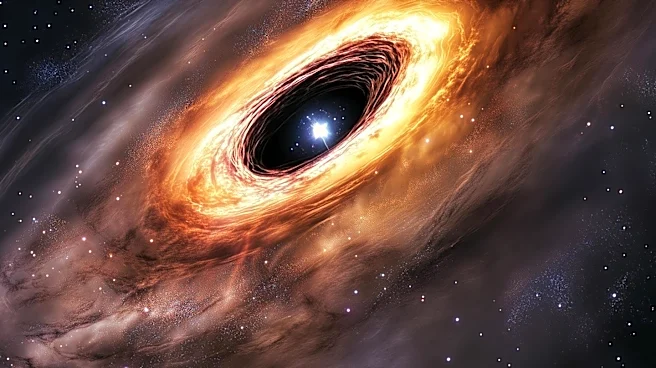
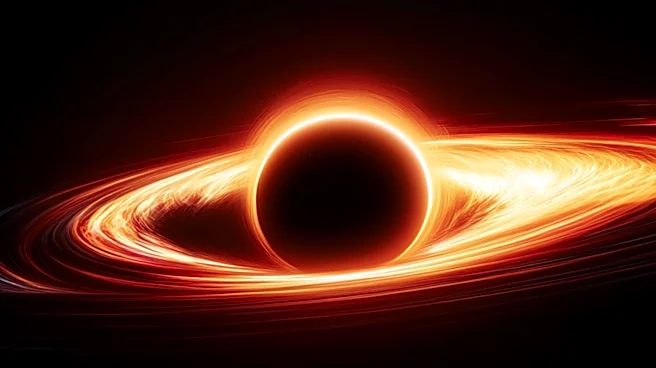
Recent studies have revealed that gravitational waves, detected by instruments like LIGO, Virgo, and KAGRA, are uncovering hidden subpopulations within black hole mergers. Two independent research teams have found that merging black holes do not form
a single uniform group but instead separate into distinct subpopulations. These findings suggest that some black holes are 'second-generation' events, formed from previous mergers rather than the collapse of massive stars. This discovery provides new insights into the formation mechanisms of black holes and their evolutionary paths.
Why It's Important?
The identification of distinct subpopulations within black hole mergers has significant implications for our understanding of black hole formation and evolution. This research challenges previous assumptions about black hole origins and suggests that some black holes may have undergone multiple mergers. Understanding these processes is crucial for explaining how black holes reach certain mass ranges and how supermassive black holes at the centers of galaxies might have formed. As gravitational-wave detectors become more sensitive, these findings could lead to a more detailed understanding of the universe's most enigmatic objects.