

What's Happening?
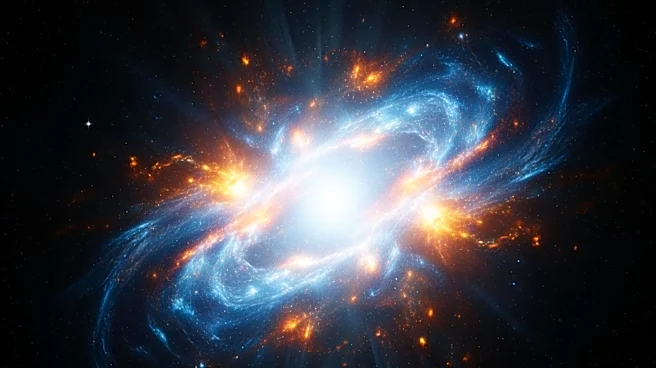
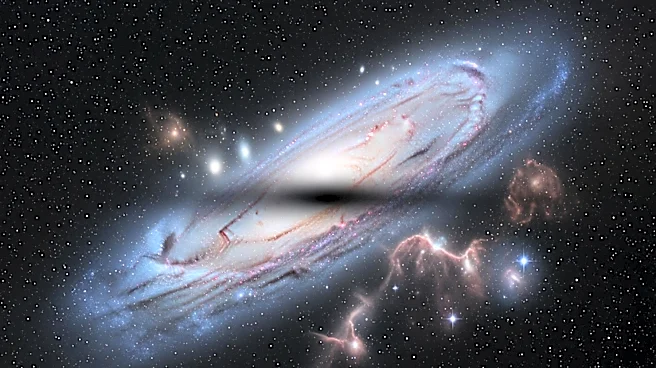
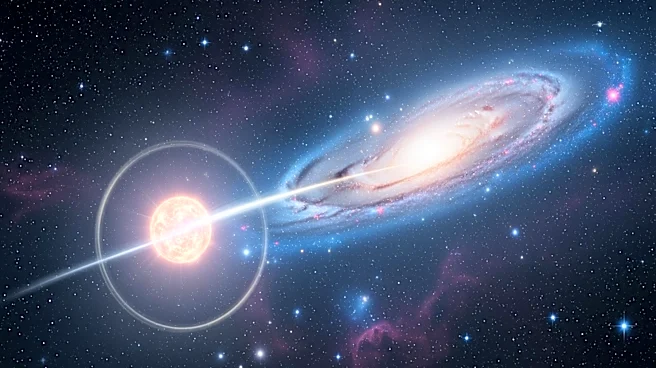
Astronomers have observed a significant decline in brightness of a galaxy due to the starvation of its supermassive black hole. Over the past 20 years, the galaxy has dimmed by 95%, a change attributed to a reduction in the flow of gas and dust to the black hole's
accretion disk. This phenomenon was studied by an international team of astronomers who utilized data from various telescopes, including the Gran Telescopio Canarias, the Subaru Telescope, and the W. M. Keck Observatory. The research, published in the journal Publications of the Astronomical Society of Japan, highlights the rapid variability in the activity of supermassive black holes, challenging existing models that suggest such changes occur over thousands of years.
Why It's Important?
This discovery is significant as it challenges current models of black hole feeding, which typically suggest that changes in brightness occur over much longer timescales. The rapid decline in brightness observed in this galaxy indicates that supermassive black holes can experience significant changes in activity within a human lifetime. This has implications for our understanding of galactic evolution and the dynamics of black holes. The findings could lead to revisions in theoretical models and enhance our comprehension of the processes governing black hole accretion and the impact on their host galaxies.
What's Next?
The research team plans to continue their investigation by using wide-field survey data to discover more galaxies exhibiting similar behavior. This could provide further insights into the mechanisms behind the shutdown and restart of supermassive black hole activity. The team aims to develop new theoretical models to explain the rapid variability observed, which cannot be accounted for by standard models. Understanding these processes could have broader implications for astrophysics and the study of cosmic phenomena.
Beyond the Headlines
The phenomenon observed in this galaxy raises questions about the long-term stability of supermassive black holes and their role in shaping the structure and evolution of galaxies. The rapid changes in brightness could indicate a dynamic interplay between the black hole and its surrounding environment, potentially influenced by external factors such as nearby cosmic events or interactions with other galaxies. This research may also prompt further exploration into the ethical and philosophical implications of our understanding of the universe and the forces that govern it.