





What's Happening?
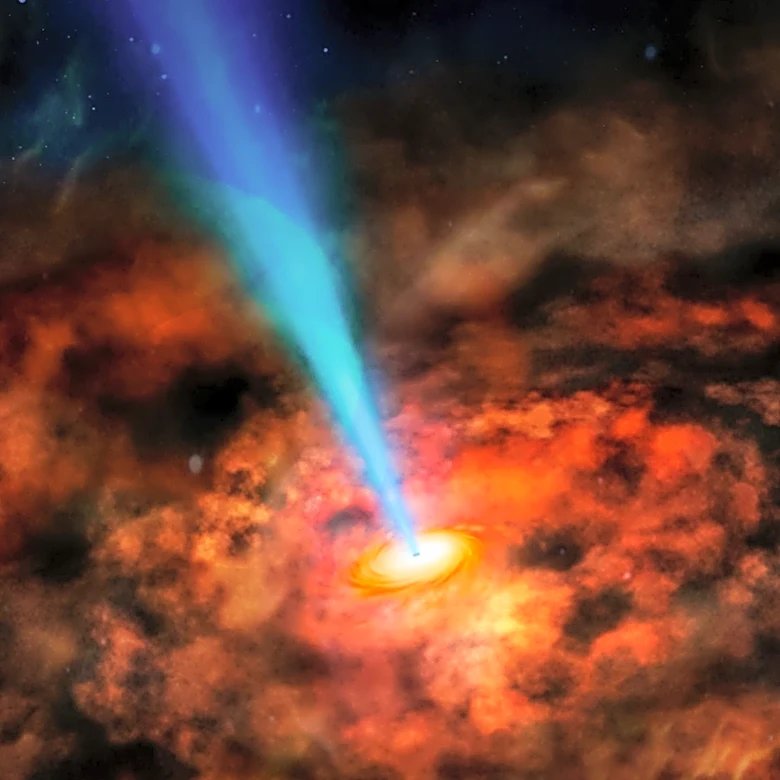
A new theoretical study published in Physical Review D suggests that black holes, traditionally considered indivisible, could split into two under extreme conditions, specifically when spinning at nearly the maximum possible speed. This idea challenges
the long-held belief that black holes resist splitting due to fundamental thermodynamic principles, which state that the total entropy would decrease if a single black hole split into two smaller ones of the same combined mass. However, a team led by Francesco Sannino, a professor of physics at the University of Naples Federico II, found that extremely rapid rotation alters the classical relationship between mass and entropy, potentially making splitting thermodynamically favorable. If such a split were to occur, the single event horizon would divide into two separate cones, creating a 'pair-of-pants' topology in spacetime. The study also explored scenarios involving additional spatial dimensions and alternative theories of gravity, where splitting could become more favorable, especially if one fragment is significantly smaller.
Why It's Important?
This theoretical breakthrough is significant because it pushes the boundaries of Einstein's theory of general relativity and our understanding of black hole behavior. The possibility of black holes splitting under extreme rotation introduces a new dynamic to cosmic evolution and could have implications for how black holes interact and evolve in the universe. It challenges the conventional view of black holes as stable, singular entities and opens up new avenues for theoretical physics, particularly in exploring the limits of known physical laws. If confirmed, this phenomenon could provide insights into the nature of spacetime under extreme conditions and potentially offer new ways to test alternative theories of gravity. The study also highlights the importance of angular momentum in black hole physics, suggesting that rotation plays a more complex role than previously understood in determining a black hole's stability and potential transformations.
What's Next?
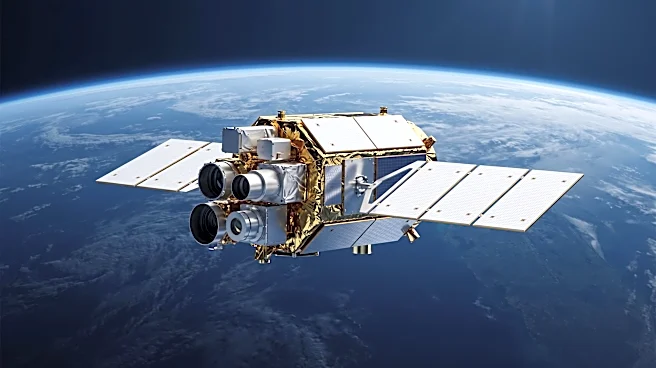
The authors have not yet estimated the precise probability of such a splitting event, as it depends on the behavior of gravity beyond Einstein's classical theory. Future research will likely focus on refining these theoretical models and exploring the conditions under which such splits could occur. Scientists will also investigate potential indirect observational signatures of black hole fragmentation, particularly from small primordial black holes that formed early in the Universe, which are considered more likely to split than larger astrophysical objects. Space-based gamma-ray instruments, such as Fermi-LAT, could be used to search for distinctive radiation from tiny fragments resulting from such events. While currently a purely theoretical possibility, this study provides a new framework for testing the limits of modern physics and could guide future observational efforts to detect these extreme cosmic phenomena.
Beyond the Headlines
The concept of a black hole splitting, particularly into a 'pair-of-pants' topology, is a profound and visually striking image that challenges our intuitive understanding of these cosmic behemoths. It delves into the exotic realms of physics where the familiar laws of thermodynamics and general relativity might be bent or broken under extreme conditions. This research could lead to a re-evaluation of how black holes are classified and how they contribute to the overall structure and evolution of the universe. Furthermore, the exploration of additional spatial dimensions and alternative theories of gravity in this context suggests that our current understanding of the cosmos might be incomplete, and there could be hidden complexities in the fabric of spacetime that are only revealed under the most extreme circumstances. This theoretical work serves as a powerful reminder that the universe still holds many mysteries, and our scientific models are constantly evolving.