






What's Happening?
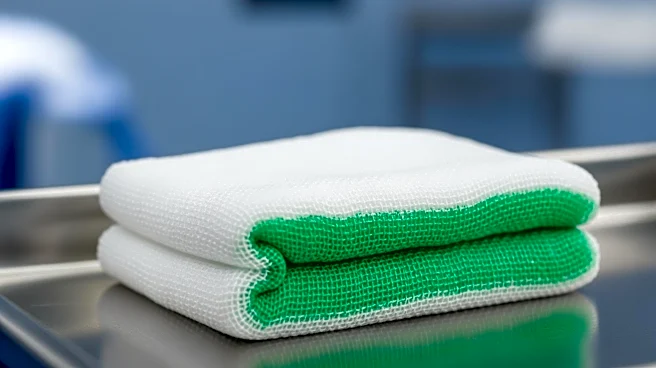
Researchers have developed a method for preparing indocyanine green (ICG)-dyed gauze using an autoclave, enhancing its near-infrared fluorescence properties. This technique involves dyeing gauze at high temperatures and pressures, followed by post-sterilization,
which improves the fixation of ICG on cotton fibers and suppresses leakage. The ICG-dyed gauze emits bright near-infrared fluorescence when irradiated, making it a promising tool for surgical applications. It can serve as a precise marker for surgeons, aiding in the identification of dissection sites and preventing gauze remnants in the patient's body.
Why It's Important?
The development of ICG-dyed gauze with enhanced fluorescence properties offers significant benefits for surgical procedures. It provides surgeons with a reliable tool for marking dissection sites, improving precision and reducing the risk of leaving gauze remnants in the body. The use of near-infrared fluorescence allows for better visualization through tissues, enhancing surgical accuracy and patient safety. This innovation could lead to improved surgical outcomes and reduced complications, highlighting the importance of integrating advanced materials in medical applications.
What's Next?
Further research and development may focus on optimizing the dyeing process and exploring additional applications of ICG-dyed gauze in various surgical contexts. The technique could be adapted for use in other medical materials, expanding its utility in healthcare. As the benefits of ICG-dyed gauze become more widely recognized, it may see increased adoption in surgical practices, potentially leading to new standards in surgical marking and visualization. Collaboration between researchers and medical professionals could drive innovation and enhance the effectiveness of this technology.