







What's Happening?
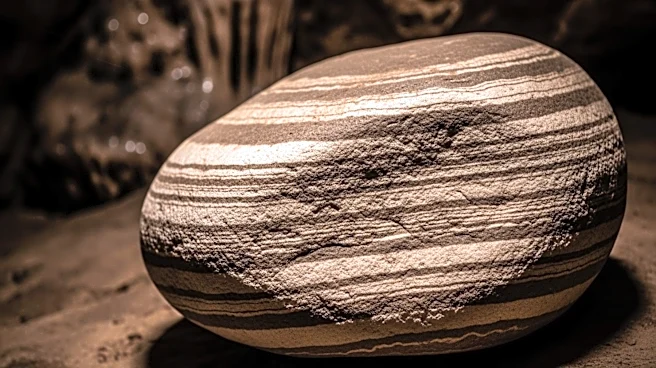
A striped rock initially dismissed as a natural phenomenon in 1928 has been reclassified as the oldest cave art in the UK, dating back 17,100 years. The discovery was made in Bacon Hole, a cave near the Mumbles in South Wales. Dr. George Nash, a specialist
in prehistoric art, led the research team that used uranium-thorium dating to confirm the age of the rock art. The painted panel, featuring horizontal bands in red pigment, was originally discovered in 1912 by professors William Sollas and Henri Breuil. The reclassification of the rock art provides significant insights into prehistoric life in Britain and north-western Europe.
Why It's Important?
The reclassification of the striped rock as prehistoric art offers new perspectives on the cultural and artistic practices of ancient inhabitants in Britain. This discovery challenges previous assumptions and highlights the advanced artistic capabilities of early humans in the region. It also underscores the importance of using modern scientific techniques to reassess historical findings, potentially leading to more accurate interpretations of prehistoric life. The recognition of Bacon Hole as a site of significant archaeological interest may prompt further research and conservation efforts, enhancing our understanding of early human history in Europe.
What's Next?
The National Trust of Wales, which oversees Bacon Hole, is expected to officially announce the research findings. This could lead to increased efforts to protect and preserve the site as a scheduled monument. The reclassification may also inspire further archaeological investigations in the region, potentially uncovering more prehistoric art and artifacts. Researchers and historians may continue to explore the implications of this discovery for understanding the migration and settlement patterns of early humans in Europe.
Beyond the Headlines
The discovery raises questions about the cultural and social dynamics of prehistoric communities in Britain. It suggests that these early inhabitants had developed complex artistic expressions, which may have played a role in their social and spiritual lives. The reclassification also highlights the evolving nature of archaeological research, where new technologies can redefine historical narratives and challenge established beliefs.