






What's Happening?
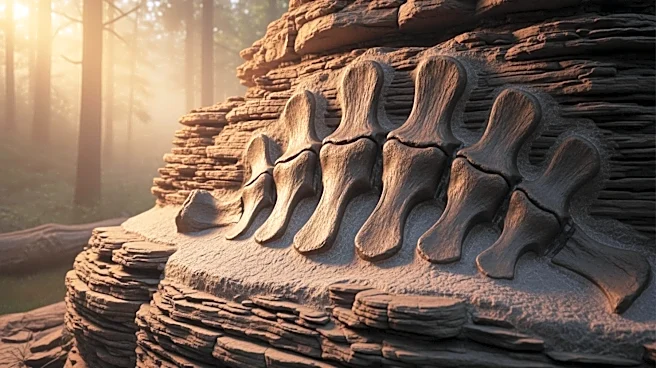
A construction site in China's Sichuan Basin has led to the accidental discovery of a massive dinosaur, Tongnanlong zhimingi, estimated to be 92 feet long. This dinosaur, part of the Mamenchisauridae family, was found in the Suining Formation, dating
back approximately 147 million years. The discovery was made by a team led by Xuefang Wei from the Chengdu Center of China Geological Survey. The fossil's preservation suggests it was buried close to where it died, indicating a calm environment. This finding challenges the East Asian Isolation hypothesis, suggesting that similar dinosaurs existed across different continents during the Jurassic period.
Why It's Important?
The discovery of Tongnanlong zhimingi provides significant insights into the distribution and evolution of sauropods, the largest terrestrial dinosaurs. It suggests that these dinosaurs were not isolated to East Asia, as previously thought, but had a global distribution. This challenges existing theories about dinosaur evolution and movement, offering new perspectives on how these massive creatures adapted to different environments. The well-preserved fossil also provides valuable information about the ecosystem of the Jurassic period, highlighting the biodiversity and environmental conditions of that era.
What's Next?
Further research will focus on analyzing the fossilized remains to gain a deeper understanding of the dinosaur's anatomy and its ecological role. Scientists will continue to explore the Suining Formation to uncover more fossils and gather additional data on the region's prehistoric environment. This discovery may lead to a reevaluation of the East Asian Isolation hypothesis and contribute to a broader understanding of dinosaur evolution and biogeography. Ongoing studies will aim to reconstruct the ancient ecosystems in which these dinosaurs lived, providing insights into their survival strategies and interactions with other species.