



What's Happening?
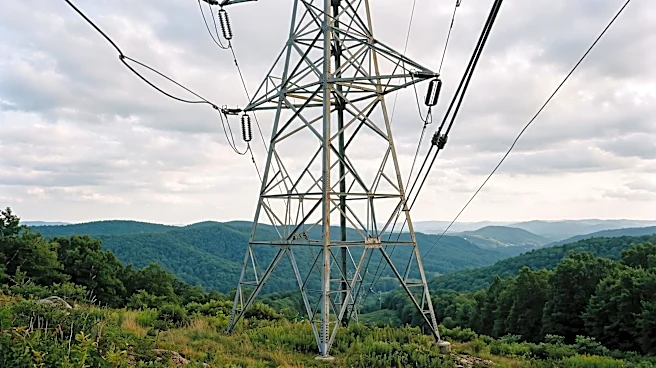
Residents of West Virginia are actively protesting the proposed Valley Link Transmission Project, citing significant concerns over eminent domain, property rights, and the increasing power demands from artificial intelligence (AI) data centers. The project
involves the construction of new power lines, which has led to fears among landowners that their property could be seized for public use without adequate compensation or consent. Protesters argue that the expansion of the power grid is primarily driven by the energy-intensive needs of burgeoning AI data centers, rather than the direct needs of local communities. This has sparked a debate about the balance between technological advancement, economic development, and the protection of individual property rights within the state. The opposition highlights a growing tension between industrial expansion and community interests.
Why It's Important?
This protest in West Virginia underscores a critical national issue concerning infrastructure development, property rights, and the environmental impact of the rapidly expanding technology sector. The reliance on eminent domain for projects driven by private industry, particularly those catering to high-demand sectors like AI, raises fundamental questions about governmental power and individual liberties. If property rights are perceived as being easily overridden for corporate interests, it could set a precedent that erodes trust in local governance and property ownership security. Furthermore, the debate highlights the substantial energy footprint of AI data centers, prompting discussions about sustainable energy solutions and the equitable distribution of infrastructure burdens. The outcome in West Virginia could influence how similar conflicts are handled across the U.S., particularly as AI technology continues to grow and demand more resources.
What's Next?
The immediate next steps will likely involve continued public demonstrations and legal challenges from West Virginia residents against the Valley Link Transmission Project. Local advocacy groups are expected to intensify their lobbying efforts with state and federal representatives to halt or significantly alter the project. Energy companies involved will likely engage in public relations campaigns to justify the necessity of the transmission lines and address community concerns, potentially offering revised compensation packages or alternative routes. Regulatory bodies will face increased pressure to scrutinize the project's environmental impact assessments and the justification for using eminent domain. The situation could escalate into prolonged legal battles, potentially leading to court injunctions or legislative interventions that could either delay or permanently alter the project's scope.
Beyond the Headlines
The conflict in West Virginia reveals deeper societal implications regarding the rapid advancement of AI and its infrastructural demands. It exposes a potential fault line between technological progress and community well-being, where the benefits of AI are often geographically distant from the environmental and social costs of its energy consumption. This situation could catalyze broader discussions about national energy policy, the regulation of data centers, and the ethical responsibilities of tech companies in mitigating their environmental footprint. It also brings to the forefront the need for transparent and equitable processes when private interests intersect with public domain powers. The outcome may influence future policy decisions on how states balance economic growth driven by technology with the protection of citizens' property rights and environmental concerns, potentially leading to new frameworks for infrastructure development in the digital age.