
What's Happening?
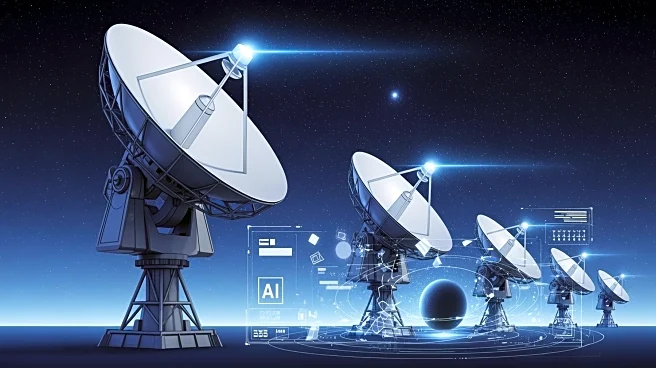
NASA has developed an updated version of its ExoMiner software, named ExoMiner++, which utilizes artificial intelligence to identify potential exoplanets from data collected by the Transiting Exoplanet
Survey Satellite (TESS). This open-source software builds on the success of its predecessor, which validated 370 exoplanets using data from the Kepler mission. ExoMiner++ has been trained on both Kepler and TESS data, allowing it to sift through vast amounts of astronomical data to distinguish between exoplanet signals and other celestial phenomena. The software has already identified 7,000 exoplanet candidates from TESS data, which require further observation for confirmation. The tool is available for download on GitHub, enabling researchers worldwide to contribute to the search for new planets.
Why It's Important?
The development of ExoMiner++ represents a significant advancement in the field of exoplanet discovery, leveraging artificial intelligence to process large datasets more efficiently. This innovation not only accelerates the pace of discovery but also democratizes the process by making the software freely available to researchers globally. The ability to identify exoplanet candidates more effectively could lead to a better understanding of planetary systems beyond our own, potentially uncovering planets that could support life. Furthermore, the open-source nature of the software aligns with NASA's commitment to transparency and collaboration in scientific research, fostering a more inclusive scientific community.
What's Next?
As ExoMiner++ continues to process data from TESS, the next steps involve refining the model to improve its accuracy and capability to identify exoplanet signals directly from raw data. Future exoplanet-hunting missions, such as NASA's upcoming Nancy Grace Roman Space Telescope, will provide additional data for ExoMiner++ to analyze, potentially leading to the discovery of thousands more exoplanets. The ongoing development and application of ExoMiner++ will likely enhance our understanding of the universe and inform future space exploration missions.