





What's Happening?
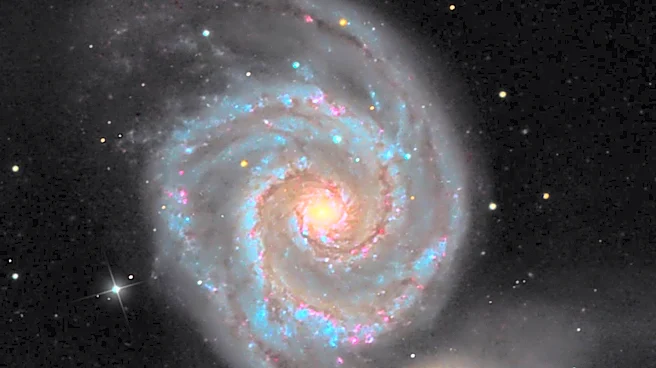
Astronomers have identified two potential reionization-limited HI clouds (RELHICs) near the Whirlpool Galaxy (M51). These starless galaxies, also known as optically dark galaxies, are theorized to exist within low-mass dark matter halos that fail to form
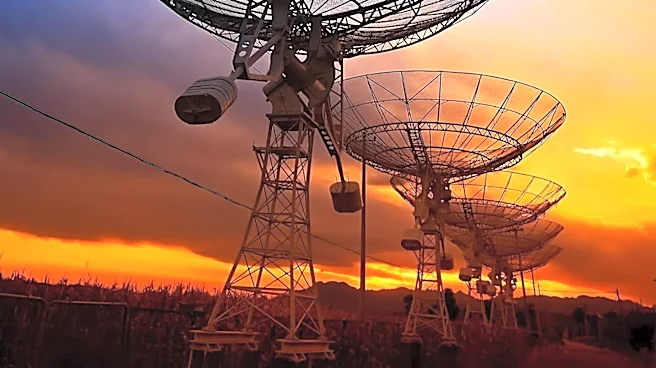
stars. The discovery was made using the Five-hundred-meter Aperture Spherical Telescope (FAST), which detected two HI clouds, named Cloud N and Cloud S, that meet the criteria for RELHICs. These clouds have a dark matter halo mass of approximately 3.7 billion solar masses and exhibit HI density profiles consistent with theoretical models. The findings suggest that these clouds could be among the few known RELHICs, providing valuable insights into galaxy formation and dark matter distribution.
Why It's Important?
The discovery of potential RELHICs near M51 offers a unique opportunity to study galaxy formation in low-mass dark matter halos. Understanding these starless galaxies could provide insights into the early universe's conditions and the role of dark matter in galaxy formation. The findings challenge existing models by suggesting that not all dark matter halos lead to visible galaxies, highlighting the complexity of cosmic structures. This research could also inform future studies on the distribution of dark matter and the processes that prevent star formation in certain environments, contributing to a more comprehensive understanding of the universe.
What's Next?
Further observations are needed to confirm the nature of Cloud N and Cloud S as RELHICs. High-resolution radio telescopes, such as the Very Large Array, could provide more detailed images to verify their shapes and structures. Additionally, optical imaging with sensitive telescopes like the Hubble Space Telescope may reveal faint stellar populations within these clouds. Continued research will focus on understanding the dynamics and composition of these potential RELHICs, which could lead to new insights into dark matter and galaxy formation theories. The scientific community will likely conduct follow-up studies to explore the implications of these findings.