






What's Happening?
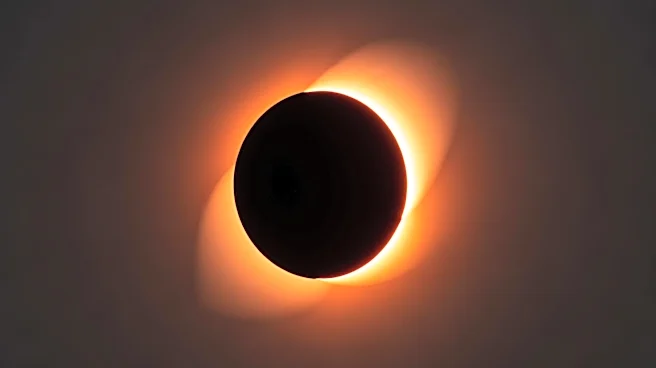
An annular solar eclipse is set to occur on February 6, 2027, creating a 'ring of fire' visible across a broad path in southern Chile, Argentina, and parts of West Africa. During this event, the moon's central shadow will not fully reach Earth, allowing
a bright ring to be visible for up to 7 minutes and 51 seconds at the point of greatest eclipse in the Pacific. This makes it one of the longest annular solar eclipses of the decade. The path of the eclipse will stretch over 9,011 miles, crossing regions with varying weather conditions, which may affect visibility. In South America, the eclipse will be best viewed in Argentina's Patagonian plains, where cloud cover is expected to be minimal. In West Africa, the eclipse will occur late in the day, with potential viewing challenges due to Saharan dust.
Why It's Important?
The 2027 annular solar eclipse is significant due to its unusually long duration, providing a rare opportunity for eclipse chasers and scientists to observe and study the phenomenon. The event will attract tourists and researchers to the regions within the eclipse path, potentially boosting local economies. Additionally, the eclipse offers a chance to raise public awareness about solar phenomena and the importance of using proper eye protection when viewing such events. The long duration of the eclipse is attributed to the moon's position near apogee and Earth's proximity to perihelion, which are key factors in the geometry of the eclipse.
What's Next?
As the date of the eclipse approaches, preparations will likely intensify in the regions along the path of annularity. Local governments and tourism boards may organize events and provide resources to accommodate the influx of visitors. Scientists and eclipse enthusiasts will continue to monitor weather patterns to identify optimal viewing locations. Educational campaigns may be launched to inform the public about safe viewing practices and the scientific significance of the eclipse. The event will also be a focal point for media coverage, highlighting the natural wonder and its impact on the regions it traverses.