
What's Happening?
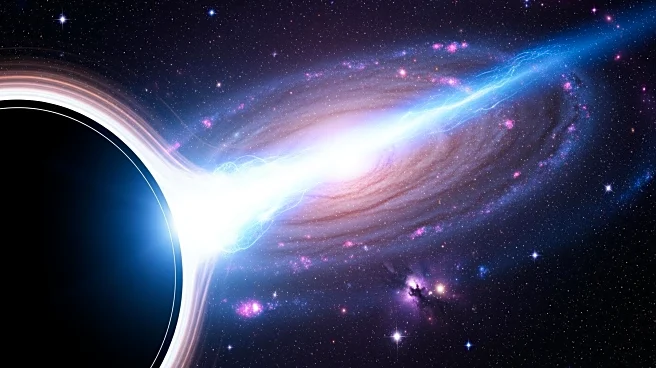
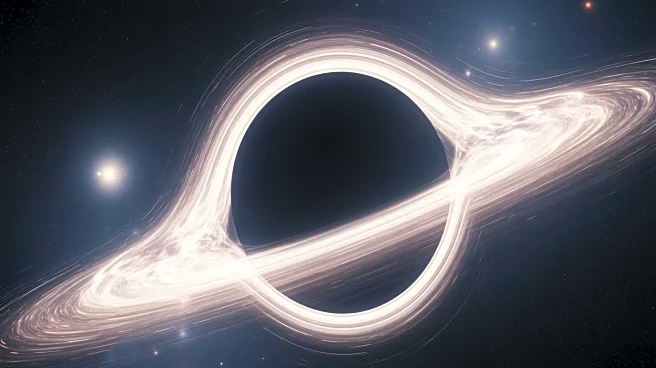
Astronomers have observed a supermassive black hole exhibiting a phenomenon known as 'Lense-Thirring precession' or 'frame dragging,' where the black hole's rapid spin drags the fabric of spacetime around
it. This observation was made by studying a star's wobble in its orbit around the black hole, which is consuming the star's material. The research, involving X-ray data from NASA's Swift Observatory and radio-wave observations from the Very Large Array, provides compelling evidence of this rare effect predicted by Einstein's theory of general relativity. The study focused on a tidal disruption event (TDE) designated AT2020afhd, where a star is torn apart by the black hole's immense gravitational forces, forming an accretion disk and emitting jets of plasma.
Why It's Important?
This discovery is significant as it offers a new method for studying the spin of black holes and the dynamics of tidal disruption events. By confirming the frame-dragging effect, scientists can better understand the mechanics of black holes and their influence on surrounding cosmic objects. This research not only validates a century-old prediction by Einstein but also enhances our understanding of the universe's most extreme environments. The findings could lead to advancements in astrophysics, providing insights into the behavior of matter under extreme gravitational forces and the nature of spacetime itself.