



What's Happening?
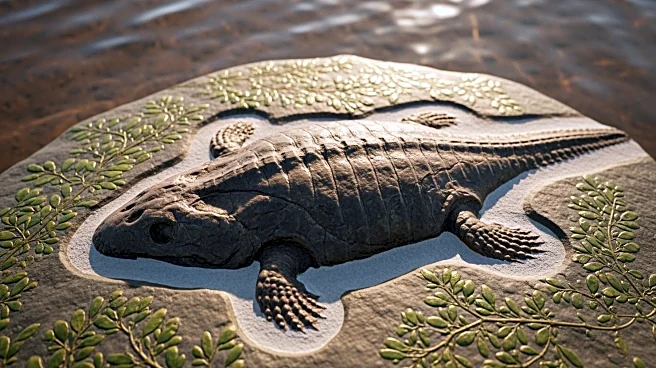
Recent research has uncovered that mosasaurs, traditionally known as ocean-dwelling apex predators during the late Cretaceous period, also inhabited freshwater environments. This discovery was made through isotope analysis of mosasaur teeth found in North
Dakota, which indicated a freshwater habitat. The study, involving researchers from Sweden, the US, and the Netherlands, suggests that these giant reptiles, some reaching lengths of 11 meters, posed a threat to dinosaurs near riverine environments. The findings challenge previous assumptions about mosasaur habitats and suggest they adapted to freshwater living in the final million years before their extinction.
Why It's Important?
The revelation that mosasaurs lived in freshwater environments expands the understanding of their ecological range and adaptability. This adaptation may have been a survival strategy during the late Cretaceous period, offering insights into the evolutionary pressures faced by marine reptiles. The study also highlights the complex interactions between different species, as mosasaurs may have preyed on dinosaurs near water sources. This research contributes to the broader understanding of prehistoric ecosystems and the factors leading to the extinction of these ancient creatures.
Beyond the Headlines
The study raises questions about the adaptability of marine reptiles and their ability to exploit diverse environments. It also prompts a reevaluation of the ecological dynamics during the late Cretaceous period, particularly the interactions between marine and terrestrial predators. The findings could lead to further investigations into the evolutionary history of mosasaurs and their role in prehistoric ecosystems. Additionally, the research underscores the importance of isotope analysis in paleontology, providing a tool for uncovering hidden aspects of ancient life.