





What's Happening?
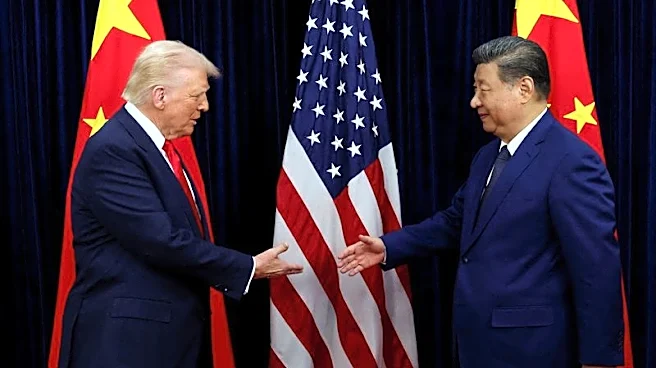
As President Trump prepares for a visit to China, the longstanding U.S. policy of strategic ambiguity regarding Taiwan is under scrutiny. This policy, which acknowledges China's claim over Taiwan while maintaining informal relations with the island, has
been a delicate balancing act for U.S. presidents for nearly 50 years. The policy aims to ensure Taiwan can defend itself without explicitly committing U.S. military intervention, a stance that has required precise diplomatic language to avoid escalating tensions with China. Past U.S. administrations have faced challenges in articulating this policy, with occasional missteps leading to diplomatic tensions. President Trump's visit could bring this policy back into the spotlight, as discussions with Chinese President Xi Jinping may touch on U.S. arms sales to Taiwan and broader U.S.-China relations.
Why It's Important?
The U.S. policy of strategic ambiguity is crucial in maintaining peace and stability in the Taiwan Strait, a potential flashpoint for U.S.-China conflict. This policy allows the U.S. to support Taiwan's defense capabilities without provoking China, which views Taiwan as a breakaway province. Any shift in this policy could have significant geopolitical implications, potentially altering the balance of power in the Asia-Pacific region. The precision of diplomatic language is vital to avoid misunderstandings that could lead to military confrontations. As President Trump engages with Chinese leaders, the handling of this policy will be closely watched by international observers and could influence future U.S.-China relations.
Beyond the Headlines
The concept of strategic ambiguity reflects broader challenges in U.S. foreign policy, where maintaining alliances and deterring aggression must be balanced with diplomatic engagement. The policy's effectiveness relies on the perception of U.S. resolve and the ability to communicate intentions clearly. Missteps in this area can lead to increased tensions and undermine U.S. credibility. The ongoing debate over this policy highlights the complexities of international diplomacy and the need for careful management of U.S.-China relations, particularly as China's global influence continues to grow.