



What's Happening?
Nevada Senators Jacky Rosen and Catherine Cortez Masto, along with seven other Democratic senators, have formally requested information from the Trump administration regarding U.S. Immigration and Customs Enforcement (ICE) activities at airports nationwide,
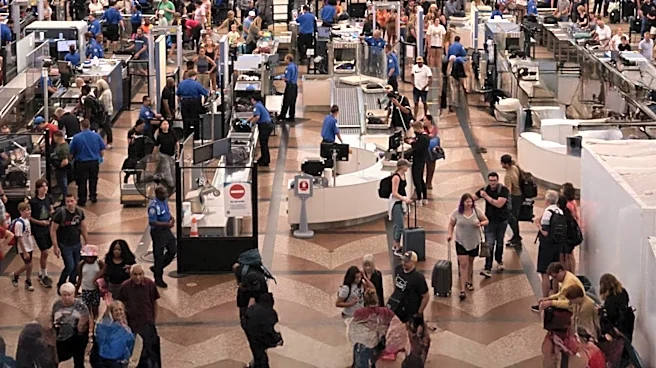
including those in Nevada, and the Transportation Security Administration's (TSA) involvement. In a joint letter addressed to Homeland Security Secretary Markwayne Mullin, Acting ICE Director David Venturella, and TSA Administrator David Cummins, the senators expressed significant concerns about recent immigration enforcement actions. They highlighted incidents such as the arrest of Marina Sardi at Reno-Tahoe International Airport and an attempted detention of Phu Nguyen at Harry Reid International Airport in Las Vegas. The senators stated that these actions are creating fear within communities, causing disruption and distress to the traveling public, and potentially harming Nevada's tourism economy. They are seeking clarification on the operational relationship between ICE and TSA, specifically inquiring about the types of information shared between the agencies.
Why It's Important?
This demand for answers from the Trump administration underscores growing concerns among lawmakers about the scope and impact of immigration enforcement at U.S. airports. The involvement of TSA in ICE operations raises questions about the agency's primary mission of transportation security versus its role in immigration enforcement. The senators' assertion that these actions instill fear and disrupt the traveling public highlights a potential conflict between security measures and civil liberties, as well as economic implications for states heavily reliant on tourism, like Nevada. The request for transparency regarding information sharing between ICE and TSA is crucial for understanding the legal and ethical boundaries of such collaborations. The outcome of this inquiry could lead to increased scrutiny of federal agencies' practices, potential policy changes regarding airport enforcement, and a reevaluation of the balance between national security and individual rights at transportation hubs.
What's Next?
The Trump administration is now expected to respond to the senators' letter, providing details on the coordination and information-sharing protocols between ICE and TSA at airports. The senators have explicitly requested explanations for these practices and are seeking to establish 'guardrails' to protect the traveling public and airport workers. Depending on the administration's response, further legislative action or public hearings could follow to address the concerns raised. Stakeholders, including civil liberties advocates, immigrant rights organizations, and the tourism industry, will likely monitor the situation closely. The ongoing debate could influence future policies regarding immigration enforcement at sensitive locations like airports, potentially leading to clearer guidelines or restrictions on how federal agencies conduct such operations. The senators' push for transparency aims to ensure accountability and mitigate the perceived negative impacts on communities and the economy.
Beyond the Headlines
The controversy surrounding ICE and TSA activities at airports touches upon deeper issues concerning the role of federal agencies in domestic enforcement and the balance between national security and individual freedoms. The perceived 'fear in our communities' and 'disruption and distress to the traveling public' suggest a broader societal impact beyond the immediate enforcement actions. This situation could fuel public debate on the extent of government surveillance and data sharing, particularly in spaces traditionally viewed as public or commercial. Furthermore, the economic argument, specifically the potential harm to Nevada's tourism economy, highlights how immigration policies can have tangible financial consequences for states and industries. The senators' intervention reflects a growing pushback against what some perceive as overreaching federal authority, potentially setting a precedent for how future administrations approach immigration enforcement in public spaces.