




What's Happening?
India and France are deepening their strategic partnership in space exploration, critical technologies, and economic security. High-level diplomatic discussions were held in Paris on November 10, 2026, co-chaired by India's Foreign Secretary Vikram Misri
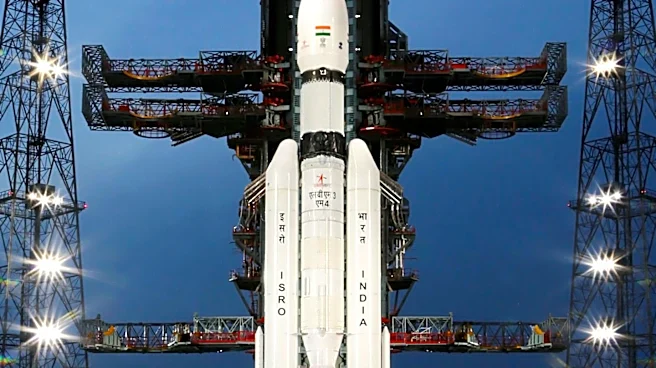
and Martin Briens, Secretary General of the French Ministry for Europe and Foreign Affairs. These discussions included the third India-France Strategic Space Dialogue and the inaugural India-France Economic Security and Critical Technologies Dialogue. The primary goals are to expand cooperation across strategic technology sectors, strengthen resilient supply chains, and review broader bilateral relations. Both nations also exchanged views on regional and international developments of mutual interest. This collaboration builds on a long-standing partnership in space technology, which began with sounding rocket experiments in the 1960s and has evolved to include joint satellite missions, launch vehicle technologies, and human spaceflight initiatives. Recent discussions in September 2026 between India's Minister of State for Science and Technology Jitendra Singh and French Minister for Higher Education and Research Philippe Baptiste also focused on expanding cooperation in human spaceflight, start-ups, and developing a new space ecosystem. The planned TRISHNA satellite mission, a joint initiative between ISRO and CNES, is another key area of collaboration, following previous joint missions like Megha-Tropiques and SARAL.
Why It's Important?
This enhanced cooperation between India and France is significant for several reasons. It underscores a global trend towards strengthening alliances in critical technological domains amidst evolving geopolitical landscapes. For India, partnering with France, a technologically advanced nation with a robust space program, provides access to advanced expertise and resources, particularly for its human spaceflight ambitions like the Gaganyaan program. This collaboration can accelerate India's technological development and reduce its reliance on other global powers. For France, deepening ties with India, a rapidly growing economy and a significant player in the Indo-Pacific, strengthens its strategic influence and opens new markets for its technology and industries. The focus on resilient supply chains in critical technologies is crucial for both nations to mitigate vulnerabilities from global disruptions and ensure economic security. This partnership also sets a precedent for other countries seeking to build robust, independent technological capabilities through international collaboration, potentially influencing future global technology and space governance frameworks. The joint initiatives in satellite development and space research will contribute to scientific advancements and practical applications benefiting both countries.
What's Next?
The ongoing dialogues between India and France are expected to lead to concrete joint initiatives and agreements in space and critical technologies. Future steps will likely include further collaboration on satellite development, space research, commercial space activities, and emerging applications. The technical assistance from France to India's Gaganyaan program is anticipated to continue, potentially accelerating India's human spaceflight capabilities. The TRISHNA satellite mission will progress, and new joint projects in space and technology are likely to be identified. Both countries will continue to explore opportunities for collaboration between government institutions, research organizations, and industries, fostering innovation and economic growth. The focus on strengthening supply chain resilience will likely translate into specific projects aimed at securing critical industrial and technological ecosystems. These discussions are part of a broader effort to strengthen India-France relations through regular diplomatic engagement, suggesting a sustained commitment to this strategic partnership in the coming years.
Beyond the Headlines
Beyond the immediate technological and economic benefits, this deepening partnership between India and France carries broader implications. It signifies a strategic alignment between two nations that share democratic values and a vision for a multipolar world, potentially serving as a counterweight to other dominant global powers. The emphasis on technology sharing and capacity building, rather than a purely transactional approach, could foster greater technological independence for India and strengthen its position as a global technological hub. Ethically, such collaborations can promote responsible space exploration and the peaceful use of outer space, setting standards for international cooperation. Legally, these partnerships may necessitate new frameworks for intellectual property sharing, data governance, and regulatory harmonization in advanced technological sectors. Culturally, increased scientific and technological exchange can lead to deeper understanding and collaboration between the two nations' scientific communities and broader societies, fostering long-term diplomatic ties and mutual trust. This strategic alliance could also influence global norms for technology development and transfer, promoting a more equitable distribution of technological capabilities worldwide.