


What's Happening?
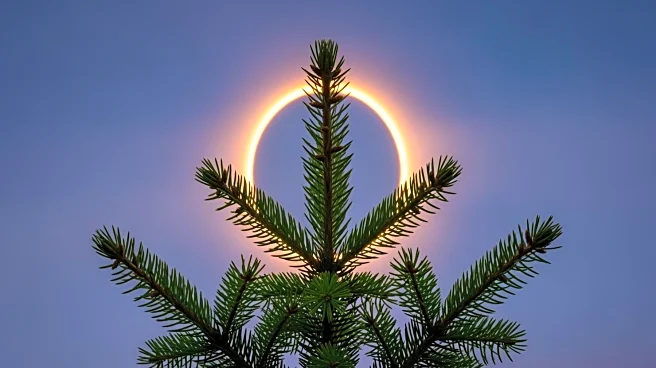
A recent study conducted in the Dolomites, Italy, suggested that spruce trees might have the ability to 'anticipate' solar eclipses through synchronized electrical responses. The research, led by Alessandro Chiolerio from the Italian Institute of Technology,
involved attaching sensors to the trees to measure their bioelectric signals. The team observed a distinct synchronization of these signals during a solar eclipse in 2022, which they attributed to the trees' response to the eclipse. However, this conclusion has been challenged by Ariel Novoplansky from Ben-Gurion University, who argues that the observed electrical activity could be due to other environmental factors, such as nearby lightning. Novoplansky's critique, published in Trends in Plant Science, questions the validity of the original findings, suggesting that the trees' response might not be related to the eclipse at all.
Why It's Important?
The debate over the spruce trees' response to solar eclipses highlights the complexities of interpreting bioelectric signals in plants and the challenges of attributing causality in ecological studies. If the original findings are validated, it could open new avenues in understanding plant communication and their interaction with environmental phenomena. However, the skepticism from Novoplansky underscores the need for rigorous testing and replication of such studies to avoid misinterpretation. This discussion is significant for the scientific community as it emphasizes the importance of critical evaluation and the potential for alternative explanations in ecological research.
What's Next?
Further research is needed to conclusively determine whether the spruce trees' electrical responses are indeed linked to solar eclipses or if they are influenced by other environmental factors. Chiolerio has expressed openness to collaborative experiments, suggesting that a similar study during a total eclipse could provide more definitive results. The scientific community may also explore additional environmental variables, such as cosmic rays and magnetic fields, to better understand the factors influencing the trees' bioelectric activity.