



What's Happening?
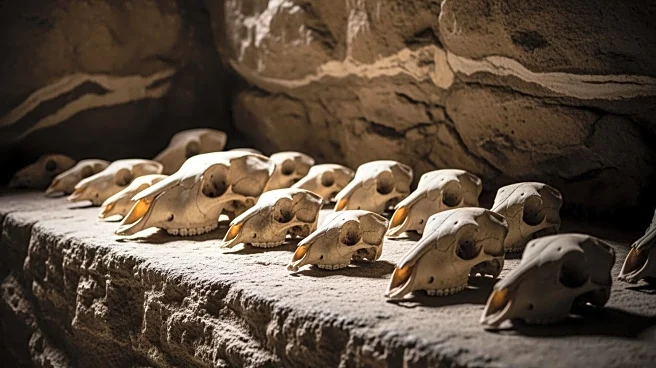
A recent study has uncovered that Neanderthals, over 43,000 years ago, engaged in the cultural practice of collecting and positioning horned and antlered animal skulls in a cave in what is now Spain. This discovery was made in the Des-Cubierta cave in central
Iberia, where researchers found 35 large mammal skulls, primarily from species like steppe bison and aurochs, alongside over 1,400 stone tools typical of Neanderthals. The study, led by Lucía Villaescusa Fernández, suggests that these skulls were purposefully placed and not related to subsistence needs, indicating complex cultural behaviors. The findings challenge previous assumptions about Neanderthal symbolism and suggest a unique cultural tradition transmitted over generations.
Why It's Important?
This discovery is significant as it provides new insights into the cultural practices of Neanderthals, suggesting they had complex social behaviors and traditions. Understanding these practices helps reshape the narrative around Neanderthals, often perceived as lacking symbolic thought. The study highlights the importance of distinguishing human activity from natural processes in archaeological records, offering a more nuanced view of Neanderthal societies. This could influence future research on human evolution and the development of cultural practices, potentially altering how we perceive the cognitive abilities of Neanderthals compared to Homo sapiens.